.svg)

Sustainable Sourcing: A Strategy for Decarbonisation
Your procurement decisions directly shape your company's carbon footprint. Every supplier choice and category strategy can either accelerate or stall your journey to net zero. Without reliable emissions data, procurement teams often treat decarbonisation as an afterthought. DitchCarbon provides the verified data and tools to make sustainable sourcing your default, embedding carbon intelligence into every decision.
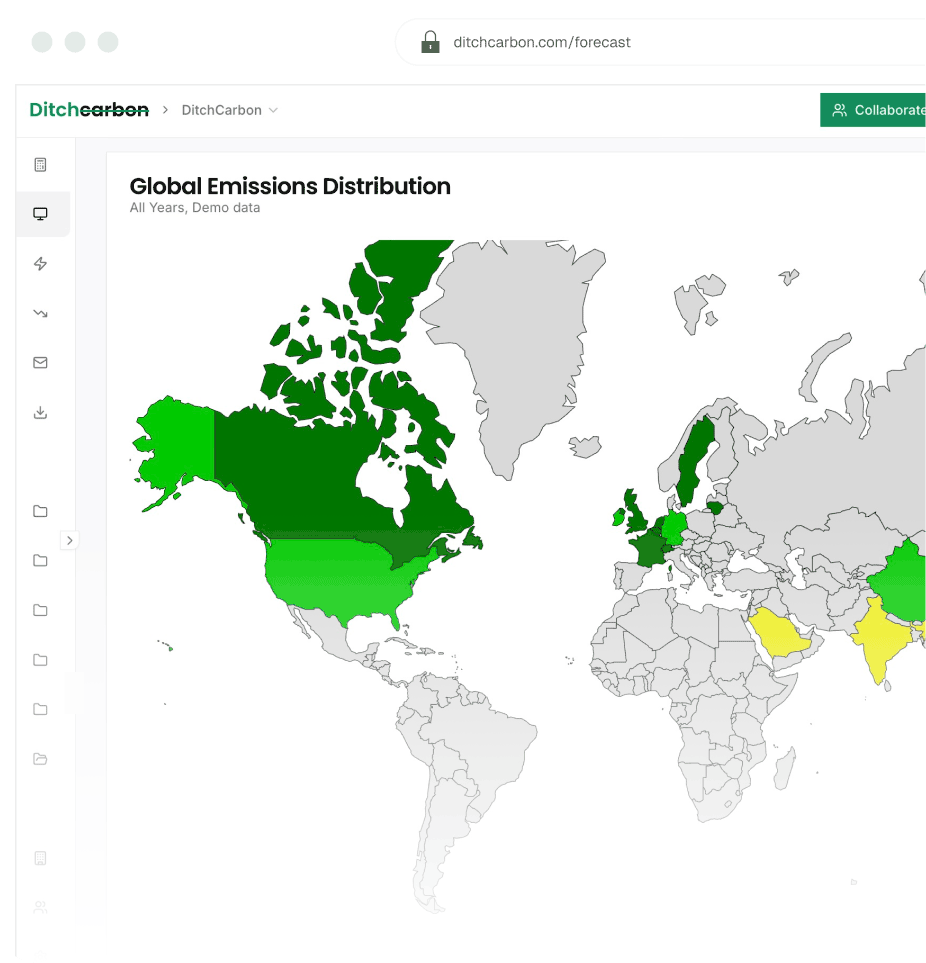

70–90% of emissions sit in purchased goods and services

Integrate carbon data for sustainable sourcing

Make decarbonisation a core sustainable sourcing metric

Empower buyers with clear, actionable emissions data

Turn procurement into a decarbonisation engine
Explore this
use case
Make climate-smart sourcing the default across every supplier decision.
Why sustainable sourcing matters
Procurement drives the majority of emissions. For most organisations, 70–90% of emissions are tied to purchased goods and services.
Cost, risk, and emissions are now intertwined. Stakeholders expect procurement to reduce climate risks, deliver transparency, and source from suppliers aligned with sustainability goals.
Sourcing decisions shape long-term impact. Choosing low-carbon suppliers and incentivising supplier action accelerates progress across the entire value chain.
Sustainable sourcing isn't just good practice-it's the most powerful lever you have to cut Scope 3 emissions.
Four steps to optimise your sustainable sourcing
1. Source with verified data
- Access supplier-specific, auditable emissions profiles
- Compare suppliers on emissions intensity alongside cost, quality, and risk
- Spot high-emitting categories before contract renewal
2. Prioritise low-carbon suppliers
- Use emissions scoring to guide supplier selection
- Benchmark suppliers against peers and industry standards
- Reward suppliers who are aligned with science-based targets
3. Integrate climate into RFPs and contracts
- Add emissions performance as a standard evaluation criterion
- Track supplier climate commitments in procurement systems
- Build decarbonisation expectations directly into sourcing agreements
4. Measure and report impact
- Monitor supplier progress against emissions-reduction targets
- Capture evidence for SBTi and regulatory disclosures
- Show procurement's contribution to corporate net zero goals
Support SBTi targets with sustainable sourcing
With DitchCarbon, procurement teams can:
- Identify suppliers with or without SBTi-aligned targets
- Influence vendors during sourcing moments
- Track adoption and progress over time
- Build evidence packs for SBTi validation
- Focus collaboration where it drives the biggest reductions
Turn sourcing decisions into a measurable driver of Scope 3 decarbonisation.
Related articles




Frequently asked questions
Get answers to the questions procurement and sustainability teams ask most often.
A sustainable sourcing strategy is the practice of integrating climate and environmental criteria-with a strong focus on carbon emissions-into your procurement processes. It moves beyond traditional factors like cost and quality to include supplier climate performance as a key decision-making metric, aiming to reduce your organisation's overall Scope 3 footprint.
Since the majority of a company's emissions come from its supply chain (purchased goods and services), the procurement team has the most direct influence on Scope 3 reduction. By using verified, supplier-specific carbon data as part of a sustainable sourcing strategy, procurement can select lower-emission suppliers, negotiate for climate commitments, and track performance over time, making it the most effective lever for decarbonisation.
Focus on empowerment, not extra workload. Frame sustainable sourcing as a way to enhance their strategic value, manage future risks, and make better-informed decisions. Provide them with easy-to-use tools, like supplier scorecards and benchmarks, that integrate into their existing workflows. Show them that good data makes it simple to factor carbon into decisions without slowing them down.
To make credible comparisons, you need verified, supplier-specific emissions data, not just industry averages. This includes their reported Scope 1 and 2 emissions, information on any science-based targets they have set, and third-party assurance statements. A platform like DitchCarbon consolidates this data, normalises it, and presents it in a simple, comparable format like an emissions intensity metric (e.g., tCO2e per unit of revenue).
Not necessarily. While some low-carbon alternatives may have a premium, a strategic approach often uncovers efficiencies. Resource-efficient suppliers are often more cost-efficient in the long run. Furthermore, a sustainable sourcing strategy reduces climate-related risks (like carbon taxes or reputational damage) and can improve brand value. The goal is to find the optimal balance between cost, quality, risk, and carbon performance.
The first step is to establish a data baseline. Instead of starting with mass surveys, a platform like DitchCarbon helps you get a rapid view of your supply chain emissions using existing data. This allows you to identify hotspots and prioritise your sustainable sourcing efforts for the biggest impact, fast.
Technology automates the manual work that slows down sustainable sourcing. A platform consolidates verified data from thousands of suppliers, provides tools for benchmarking, and integrates carbon insights into procurement workflows. This replaces spreadsheet management and frees up your team for strategic supplier engagement.
It's critical. A sustainable sourcing strategy provides a measurable, auditable pathway to your Scope 3 reduction targets. By systematically choosing lower-carbon suppliers and tracking their performance, you generate the evidence needed to demonstrate progress to SBTi validators and other key stakeholders.
Join the industry leaders and solve your Scope 3 emissions data challenge
See how DitchCarbon can transform your sustainability journey with auditable insights and verified data.