.svg)
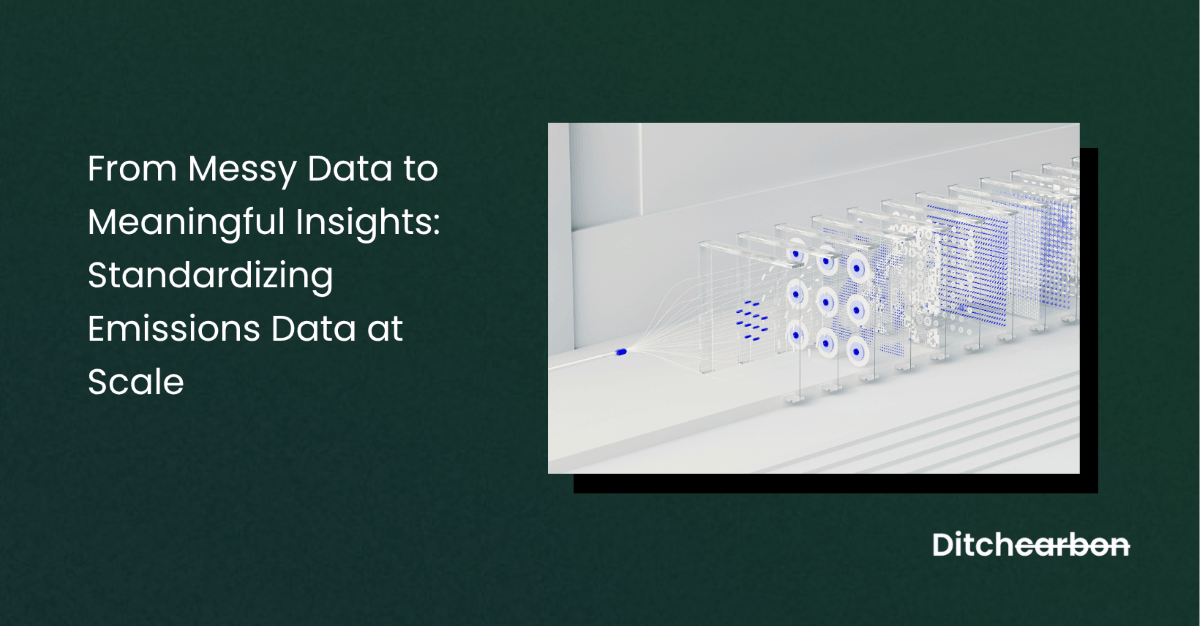
From Messy Data to Meaningful Insights: Standardising Emissions Data at Scale
Introduction
Sustainability teams are drowning in data but starving for insight. Each supplier, division, or geography reports emissions differently, different formats, different timeframes, different methodologies. Without consistency, comparing results or identifying trends becomes nearly impossible.
Standardisation is the key to turning messy data into meaningful insight. When sustainability data speaks the same language, teams can finally move from collection to action.
The Problem With Fragmentation
Most companies rely on a patchwork of data sources: supplier surveys, spend databases, internal systems, and external benchmarks. Each follows its own logic. The result? Fragmentation. Data might be correct in isolation but incompatible in aggregate.
This lack of alignment makes it impossible to:
- Compare suppliers on a like for like basis.
- Track progress year over year.
- Build accurate models of supply chain emissions.
Data chaos leads to frustration, and, often, stalled climate action. This is why humans shouldn't have to clean carbon data manually.
The Role of Standardisation
Standardisation means applying consistent definitions, units, and methodologies across all data sources. It ensures that everyone, from procurement to sustainability to finance, is working from the same foundation.
Global frameworks such as Defra, GLEC, and EPA provide reference points for emissions factors and activity types. Explore our top 10 Scope 3 emission factor databases for detailed comparisons. Aligning to these standards enables comparability and transparency.
For region specific guidance, see our regional playbook for UK, EU, US, and APAC databases.
The Process of Harmonisation
Effective standardisation involves:
- Mapping existing data to recognised categories (e.g., transportation, materials, energy use).
- Normalising units and timeframes, converting all data into consistent forms.
- Applying uniform emission factors across similar activities.
- Documenting assumptions to maintain transparency and repeatability.
This process transforms disconnected inputs into a unified, actionable dataset.
Benefits of Consistency
When data is standardised, it becomes more powerful:
- Comparability: You can benchmark suppliers and regions confidently.
- Credibility: Auditors and regulators trust consistent methodologies.
- Efficiency: Less time spent cleaning, more time interpreting.
- Scalability: Adding new suppliers or data sources doesn't break the system.
In short, standardisation multiplies the usefulness of every data point you already have.
Insights That Drive Action
Standardised data isn't just cleaner: it's smarter. With consistent inputs, teams can identify trends, predict risk, and target decarbonisation where it matters most. For example, comparing suppliers by emissions intensity per dollar spent helps prioritise engagement and investment.
Consistency also enables automation, making future updates faster and less labour intensive.
Conclusion
Messy data is inevitable; confusion isn't. By embracing standardisation, sustainability teams can turn fragmented information into actionable insight. A consistent framework doesn't just improve reporting: it accelerates reduction. Clean, comparable data is the foundation of every credible climate strategy.