.svg)
Comparing supplier emissions when disclosure differs

Compare suppliers only on the Scope 3 categories that are relevant to their industry. Start from each supplier's corporate-level GHG inventory, keep Scope 1, Scope 2 and the relevant Scope 3 categories, and build a supplier-specific spend-based emission factor from those alone. If a supplier has not disclosed a relevant category, do not build a factor for it. Run an engage campaign to request the missing figure. Suppliers in the same industry then compare like for like.
Why does the consultancy that skips business travel look cleaner?
It looks cleaner because its total is missing a category that matters for consultancies. When suppliers disclose different Scope 3 categories, a raw comparison rewards whoever reported less. The firm has not cut any emissions. It has left a category out of the count.
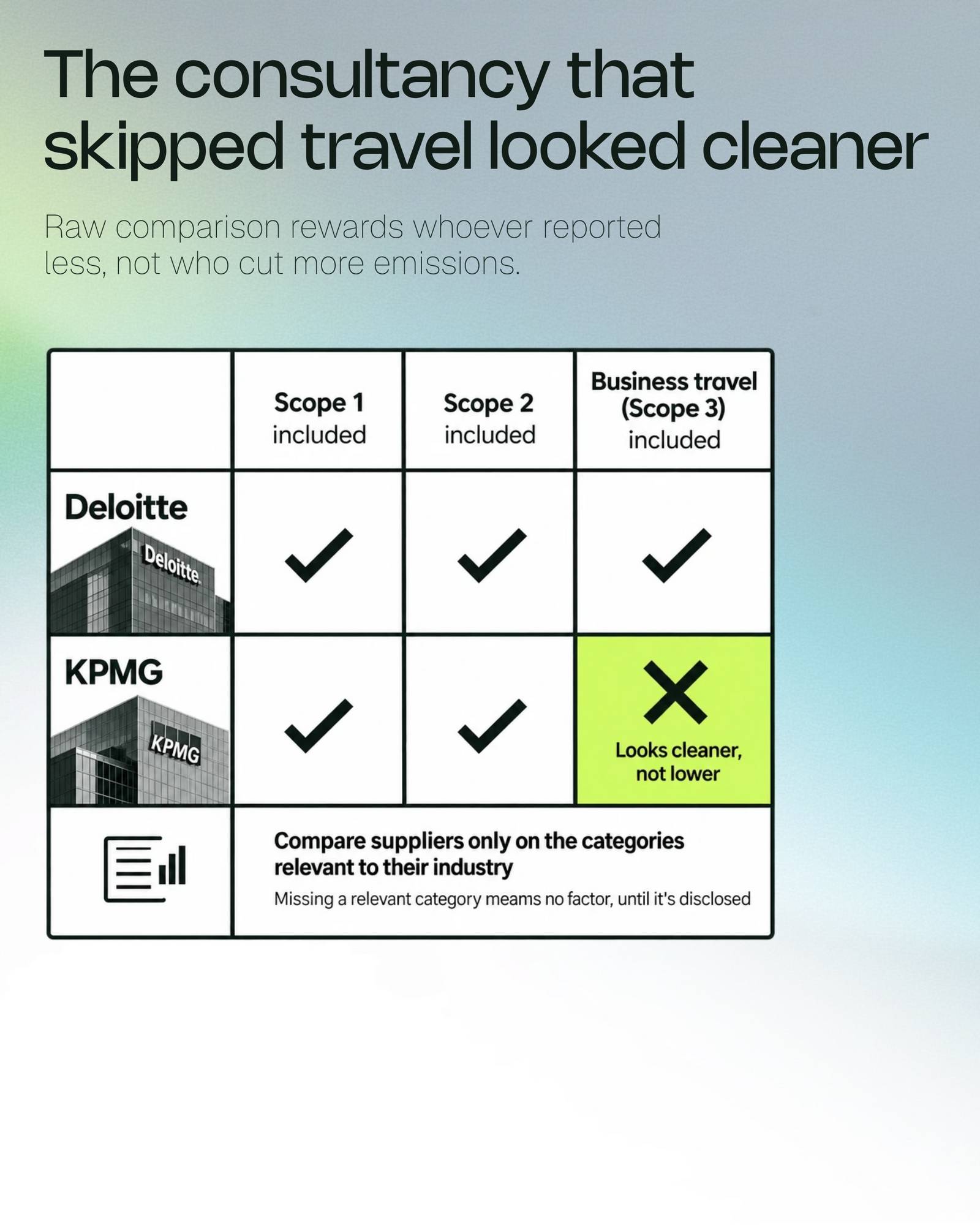
Picture two consultancies of similar size. Both send you a corporate GHG inventory. Both report Scope 1 and Scope 2. The first also reports business travel. The second does not. Divide each total by your spend with them, and the second firm comes out with the lower intensity. On paper, it is the better supplier.
This is the same as comparing two firms' costs when one left out payroll. A consultancy sells people's time, and those people travel to clients. Business travel is part of how the work gets delivered, much as payroll is part of what the work costs. Take it out of one side and the comparison says nothing about which firm runs leaner. The gap measures what each firm chose to report, and nothing about how it operates.
Most sustainability and procurement teams have seen a version of this. A supplier drops down the rankings the year it improves its disclosure, because a category that was always there finally appears in the number. The supplier behaved well, and the league table punished it.
The fix starts with deciding which categories have to be present before two figures can sit next to each other.
What does a ranking built on patchy disclosure cost you?
It costs you a ranking you cannot defend. When thin reporters look clean, your supplier scorecards reward the least transparent organisations, and your engagement effort goes to the wrong places. When an auditor or a customer asks why one supplier ranks above another, the honest answer is that it disclosed less.
That answer does not hold up under CSRD. ESRS 1 says that when preparing its sustainability statement, the undertaking shall apply relevance and faithful representation, and the enhancing characteristics of comparability, verifiability and understandability. A supplier comparison that mixes complete and partial inventories fails on comparability. It fails on faithful representation too, because the figure implies a performance gap that does not exist.
The damage depends on the industry. A missing category distorts a ranking only when that category matters for the supplier's peer group. The same omission can be harmless in one sector and decisive in another:
Back to the payroll comparison. A finance team would not sign off a cost benchmark where one company's figures left out wages. The same standard applies here. Before you rank anyone, every supplier in the peer group has to carry the same relevant categories.
How do you build a supplier factor that compares fairly?
Build it from the supplier's corporate-level GHG inventory, using only the categories relevant to that supplier's industry. Check which Scope 3 categories matter for the sector, confirm the supplier has disclosed them alongside Scope 1 and 2, and turn that set into a supplier-specific spend-based emission factor.
The method works by using the corporate-level inventory, checking the relevant categories for the industry, and using that to create a supplier-specific spend-based factor. The factors are comparable within an industry because only the categories relevant to that industry are counted.
Three things change when you work this way.
- The factor reflects the supplier's own reported emissions, so you move off a sector average for that spend.
- The boundary is fixed by the industry and applies to every supplier in it. A supplier cannot shrink its factor by leaving out a relevant category.
- Categories that do not matter for the industry have no effect either way. Reporting them does not penalise a supplier, and leaving them out does not help it.
The factor is still spend-based. You multiply it by what you spend with that supplier, as you would with a published factor set such as CEDA, DEFRA or EPA. The difference is that the number behind it belongs to the supplier, and it was built to the same category boundary as its peers.
Provenance matters here as well. When every figure carries its source and change history, you can show an auditor which inventory a factor came from and which categories went into it.
Which categories count for a mining company versus a consultancy?
Every organisation needs to disclose Scope 1 and Scope 2. For Scope 3, relevance depends on the industry. Business travel is not a relevant category for a mining company, so a missing travel figure does not matter. For a consultancy it is relevant, so a missing travel figure means the inventory is incomplete.
The same category gets different treatment in the two industries:
The example I always use is a mining company. Everyone has to disclose Scope 1 and 2. On Scope 3, business travel is not relevant to a miner, so I do not worry whether they report it or not. If they are a consultant, it very much matters.
This is why the table is not a comparison between industries. You would never rank a miner against a consultancy. The point is that each industry sets its own list of what has to be present, and the list is applied to every supplier inside that industry. Miners are checked against the miners' list and consultancies against the consultancies' list.
It also explains why chasing total disclosure is the wrong target. Asking a mining supplier for business travel adds admin for both sides and changes nothing in the comparison. Asking a consultancy for it closes the gap that made the thin reporter look clean. Put your effort on the categories that are relevant and missing.
What happens when a supplier leaves out a relevant category?
No factor gets built. If a supplier has not disclosed every category relevant to its industry, a partial figure would sit next to complete ones and repeat the trap from the start of this piece. The next step is an engage campaign that asks the supplier for the missing piece.
The rule is stated plainly in a video on the BDO Australia YouTube channel: "if they do not disclose all of those, then we do not give you the emission factor. You can then run an engage campaign and then ask them for the missing piece."
That turns a data gap into a specific request. You are not sending a cold survey that asks for everything. You are telling a consultancy that you hold its Scope 1 and 2, and that business travel is the one figure standing between it and a supplier-specific factor. Prepopulated requests like this get higher supplier response rates than a cold survey, because the supplier can see what you already have and what is left to fill.
Engagement pays off beyond the single figure. CDP reports that corporates that engage with suppliers on climate-related issues are almost 7x more likely to have a Scope 3 target and a 1.5°C-aligned transition plan. CDP also finds that only four in ten corporates engage with their suppliers.
The same rule covers private and unlisted suppliers that publish no inventory at all. Nothing is disclosed, so no factor is built, and the engage campaign becomes the way to get a first figure. Until one arrives, keep that spend on a published sector factor and show the coverage gap in your reporting.

Can you compare Deloitte and KPMG like for like?
Yes. Deloitte and KPMG are both consultancies, so both factors are built from the same set: Scope 1, Scope 2 and the Scope 3 categories relevant to consultancy, including business travel. If both have disclosed that set, the two supplier-specific factors sit side by side with no apples-to-oranges problem, and the gap between them reflects how each firm operates.
This is the comparison the opening example could not give you. There, one consultancy looked cleaner because it skipped travel. Here, neither firm can do that, because a factor without travel is never built. Both cost sheets include payroll, so the benchmark means something.
The ranking is also defensible. When someone asks why one firm's factor is lower, you can point to the inventory each factor came from and the categories that went into it. You are not relying on one firm having reported less. That is the comparability ESRS 1 asks for, applied at supplier level.
The same approach scales across a supplier base. Group suppliers by industry, apply that industry's list of relevant categories, build factors for those that pass, and send engage campaigns to those that do not. Each peer group becomes a fair comparison, and each gap becomes a named request to a named supplier.
Compare what matters to the industry, then ask for the rest.
Frequently asked questions
How do you compare supplier emissions when suppliers disclose different Scope 3 categories?
Compare them only on the categories relevant to their industry. Take each supplier's corporate-level GHG inventory, keep Scope 1, Scope 2 and the relevant Scope 3 categories, and build a supplier-specific spend-based emission factor from those. Suppliers in the same industry are then counted to the same boundary.Is it fair to compare a supplier that reports more categories with one that reports fewer?
Not on raw totals. The supplier that reports fewer categories will look cleaner even if it emits the same or more. The fair approach checks that both have disclosed every category relevant to their industry before any figures are compared.What should I do if a supplier has not disclosed a relevant category?
Do not build a factor from the partial inventory. Run an engage campaign that asks the supplier for the specific missing category, such as business travel for a consultancy. Prepopulated requests like this get higher supplier response rates than a cold survey.Why does business travel matter for a consultancy but not a mining company?
Scope 3 relevance differs by industry. A consultancy's people travel to clients as part of delivering the work, so leaving travel out makes its inventory incomplete. For a mining company, business travel is not a relevant category, so whether it is reported does not change the comparison.Does CSRD require supplier emissions to be comparable?
ESRS 1 lists comparability, alongside verifiability and understandability, as an enhancing qualitative characteristic that the undertaking shall apply when preparing its sustainability statement. A supplier ranking that mixes complete and partial inventories struggles to meet that standard.