.svg)
Product carbon footprint: which suppliers actually need one?

Most suppliers need only industry-level or corporate-level emissions data. Small suppliers get industry emission factors. Single-activity firms such as consultants, landlords and office furniture makers get their corporate greenhouse gas inventory. Suppliers that sell many different things need the footprint of the product you bought. A full product carbon footprint earns its cost only where rival products can be compared on it before you buy.
When does chasing product carbon footprints become the wrong priority?
Chasing a product carbon footprint is the wrong priority when the supplier's number would change neither your footprint nor your decision. The data quality hierarchy runs from industry average to supplier inventory to product footprint, and it holds up well. Each step up is more accurate. For each supplier, you still have to decide where to stop, and three questions settle it.
First, is the supplier material, through spend or through influence you can exert? Second, does it do broadly one thing, or many? Third, can you compare its products with a rival's before you buy? The answers put every supplier into one of three tiers: industry, supplier or product.
I get asked where the hierarchy of data quality breaks down as you move from industry to supplier to product. I don't think it does. Applied in the right place, it holds. From one supplier to the next, the thing that changes is whether the extra accuracy matters at all.
Procurement already works this way. Nobody gets three quotes for printer paper. Everyone gets them for a vehicle fleet. The effort follows the size of the decision, and emissions data should follow it too. Better data is always available at a price, and it is worth paying only where it moves a number in your inventory or changes what you buy.
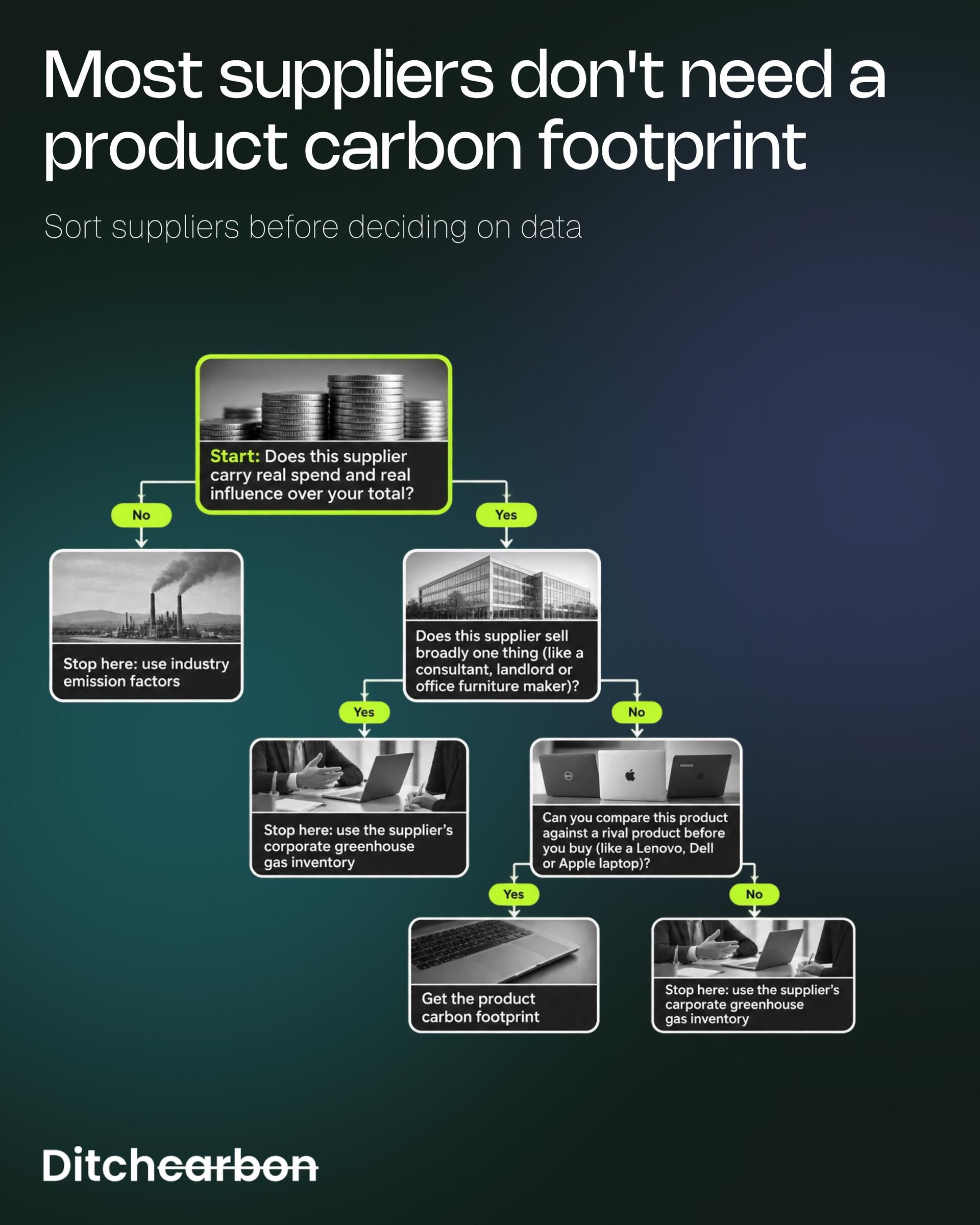
Does this supplier carry real spend and real influence?
Start with materiality. Suppose a supplier is a small share of your spend and you have no leverage over how it operates. Better data will not move your Scope 3 total and will not change the supplier's behaviour. Put it on industry factors and move on. Spend and influence decide who earns a second look.
The guidance agrees. The PACT/WBCSD Net Zero Guidebook recommends focusing first on the most material or strategic purchased products and suppliers. It says to prioritise those with the highest emissions intensity, "where data accuracy matters most". The guide Using PCAF and CDP Data Quality Scores in Private Equity calls primary data collection expensive and time-consuming. It advises building an initial inventory on proxy data to find the hotspots, and then collecting primary data there. It also notes that most firms use a combination of approaches across their portfolio.
That is the permission to run mixed tiers. The PCAF data quality score, shortened to DQ score, runs from DQ 1 to DQ 5. Some suppliers sit at DQ 5 on sector averages. A supplier that is a rounding error in your total can stay at DQ 5 without weakening the inventory.
Spend tells you whether the number matters to your total. Influence tells you whether knowing the number can lead anywhere, such as an engagement or a switch. A supplier with neither goes straight to the industry tier.
Which suppliers can stay on industry emission factors?
Small suppliers can stay on industry emission factors, and so can any supplier that fails the materiality test. Multiply spend by an industry factor from a published set such as CEDA, DEFRA or EPA, record it, and stop. The result is a sector average. For a supplier this size, a sector average is accurate enough to report.
A talk published on the Greenstone YouTube channel puts it bluntly: "there are small suppliers that you can just use industry for, don't worry about it." The same talk adds that "you can stop there for most of your suppliers."
This tier also handles private and unlisted suppliers. A small private firm rarely publishes an inventory and rarely answers a survey, and it does not need to. Match it to the right industry and apply that industry's factor. Use an identifier such as its DUNS number or VAT registration rather than a trading name that may be spelled five ways in your ledger. In PCAF terms, this is economic activity-based estimation, the entry point the standards expect in a first inventory.
Chasing a stationery supplier or a local caterer for primary data buys a slightly better number that changes nothing. The follow-up emails, the unanswered surveys and the mismatched PDFs are better spent on suppliers higher up your spend list.
When is a supplier's corporate inventory enough?
A corporate inventory is enough when the supplier does broadly one thing. Consultants, landlords and office furniture makers mostly sell what you bought from them. Their whole-company greenhouse gas inventory describes your share well. Take it, allocate by spend, and stop.
A talk on the Sustainable Procurement Pledge YouTube channel makes the case for exactly these firms: for "services, consulting, things where a company does the same thing mainly... getting a corporate level greenhouse gas inventory is absolutely appropriate for calculating their carbon footprint."
Supplier-specific data pays off here at little cost. The inventory often exists already, in a CDP response, a CSRD report or a sustainability report. Replacing the sector average with the supplier's reported inventory moves its allocation from a proxy to its own reported emissions. Using PCAF and CDP Data Quality Scores in Private Equity describes reported emissions as the approach with "the highest level of accuracy and granularity". It is also a figure an auditor can trace to a published source document.
A product footprint would add nothing. A consultancy has no product line to split, and one consulting day looks much like the next. An office furniture maker's inventory is mostly office furniture. Asking these firms for PCFs sends them looking for a breakdown their business does not produce. The answer you would get back is their corporate number in a different shape.
What changes when a supplier does many different things?
When a supplier does many different things, the corporate number stops describing what you bought. A supplier with many businesses blends them all into one inventory. If you bought tablets from Microsoft, the company's data centres sit inside that blend. Allocate the corporate figure by spend and you inherit a share of a business you never touched.
The Greenstone talk makes the point with the same example: "you want to make sure that you're accounting for the tablet that you bought, not their AI center boom." The same applies to Amazon, and to any supplier where one line of business dwarfs the thing you actually buy.
Product-level reference figures exist for this case. The study Assessing embodied carbon emissions of communication user devices by combining approaches derived representative embodied emissions for 2020: 100 kg CO2e for a tablet, 200 kg CO2e for a laptop and 350 kg CO2e for a desktop PC. With those figures, a buyer can account for a tablet as a tablet, even when the supplier's own report never separates it out. The authors also flag underreporting of Scope 3 in vendors' own data as a major concern. That is another reason to anchor on a product reference figure rather than on the vendor's blend.
This is the one case where you climb a tier for accuracy alone. Nothing needs comparing yet. The number simply has to describe the right thing.
When does a product carbon footprint earn its cost?
A product carbon footprint earns its cost when you can compare rival products on it before you buy. Suppose a Lenovo, a Dell and an Apple laptop all do the job. Their footprints can then decide the purchase, and the effort of getting a footprint pays back. This is the vehicle fleet from the opening: a purchase big enough and substitutable enough to justify three quotes.
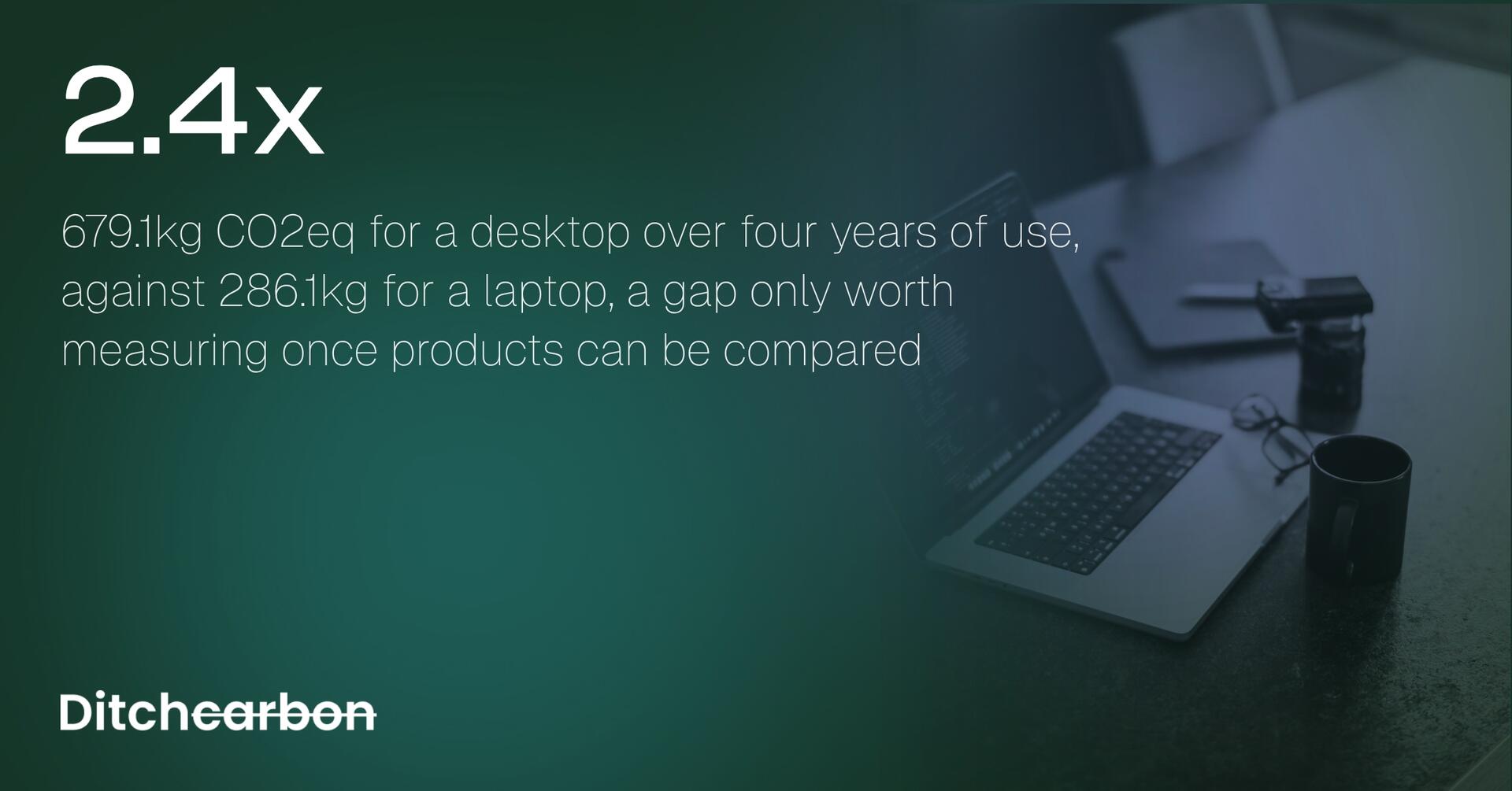
The gaps can be large. Environmental and Economic Assessment of Desktop vs. Laptop Computers: A Life Cycle Approach found the desktop system had a higher overall carbon footprint (679.1 kg CO2eq) than the laptop (286.1 kg CO2eq) over four years of use.
Manufacture is only part of the answer. An Apple laptop can carry a higher manufacturing footprint than a similar Dell and still come out lower over its working life, because it lasts longer. Apple's environment pages treat longevity as a design goal: "When products can be used longer, fewer resources need to be extracted from the earth to make new ones."
Treat the manufacturer's own figure with care. The same desktop and laptop study found that "manufacturer-provided data generally showed lower carbon footprint values than the modeled scenarios." Compare only footprints built on the same basis. That means the product-specific standards the PACT Methodology prioritises, or ISO 14067, which ISO last reviewed and confirmed in 2024. PCF rules are still maturing, so check the method before you rank products.
Every other supplier is printer paper, and nobody gets three quotes for it. Unless you run a print shop, leave the stationery supplier alone.
Frequently asked questions
What is the difference between industry, supplier and product level data for Scope 3 supplier emissions?
Industry-level data applies a sector average emission factor to your spend. Supplier-level data uses the supplier's own corporate greenhouse gas inventory, allocated to your share. Product-level data is the carbon footprint of the specific product you bought. Each tier is more accurate than the one before, and each costs more to obtain.When is an industry average accurate enough compared with actual supplier data?
An industry average is accurate enough for small suppliers and for any supplier with little spend and no influence. Better data for these suppliers will not move your Scope 3 total or change their behaviour. Guidance such as the PACT/WBCSD Net Zero Guidebook recommends focusing accuracy on the most material suppliers first.Do I need product carbon footprints from every supplier?
No. Most suppliers need only industry factors or their corporate inventory. Product carbon footprints matter in two cases: when a supplier sells many different things, and when rival products can be compared before you buy. A typical example is choosing between laptops from Lenovo, Dell and Apple.How do I estimate emissions for small private suppliers?
Match the supplier to its industry using an identifier such as its DUNS number or VAT registration, then apply that industry's emission factor to your spend. Published factor sets such as CEDA, DEFRA and EPA serve this purpose. In PCAF terms, this is economic activity-based estimation, which the standards expect in a first inventory.Does the data quality hierarchy break down anywhere?
Applied in the right place, it holds. What varies from supplier to supplier is whether more accurate data would change a number in your inventory or a purchasing decision. Where it would change neither, stop at the lower tier.