.svg)
When is a Scope 3 supplier survey worth sending?

A supplier emissions survey is worth sending only when a better number would change a decision about a supplier that matters and that you can influence. Usually it would not. Spend data and public disclosures are directionally accurate, which is enough to find your biggest suppliers and start renewable energy conversations. Primary data pays when it replaces an industry average for suppliers who are genuinely cutting. Skip small, immature, low-influence and fossil fuel suppliers entirely.
Do you need to survey every supplier before you act?
No. The field says you do: collect supplier-specific data first, then decide. For most organisations that advice turns a reduction programme into a data collection programme. The cuts wait while the surveys go out.
The advice has a respectable root. The GHG Protocol itself starts from using as much supplier-specific information as possible, falls back to physical activity data and average industry factors, and only then to a spend-based method. That hierarchy describes data quality, and it is sound.
The mistake is reading it as a sequence of action. Perfect data first, reductions later. So teams survey every supplier on the ledger, chase the ones who never reply, and spend months reconciling PDFs that do not match the portal fields. The survey becomes the work.
The standards will not settle this for you either. CSRD and ESRS E1 add their own disclosure expectations, and Scope 3 guidance keeps being revised. Waiting for a complete, settled dataset before you act means waiting indefinitely.
Frankly, most of the time the supplier survey approach stopped being worth running some while ago. You already hold enough to make directionally accurate decisions, and to get credit when the reductions happen. The question worth asking is narrower: for which suppliers would a better number change what you do? That list is much shorter than your supplier list.
What can you decide with the data you already have?
Nearly every decision that matters. Spend data and public disclosures are directionally accurate. That is enough to find your largest categories, your largest suppliers, and the suppliers who have already said they want to cut emissions. Directionally accurate is enough to act on.
Even SIMAP's guidance on purchasing data, which prefers weight-based data where it exists, is clear on this. It says dollar amounts provide an order-of-magnitude estimate that helps identify the largest categories, and that the spend-based pass is how you decide which categories deserve more detailed data. Spend is a ranking tool. Use it as one.
So the working rule is simple. Use spend to rank where your emissions sit. Use disclosures to see which of those suppliers already publish a figure, through CDP or their annual reporting. Survey only where a better number would change a decision.
That last test removes a lot of surveys. If a supplier is large, material and already discloses, you have their number. If a supplier is private and publishes nothing, the spend estimate holds the line until you have a specific reason to ask, such as a contract renewal or a reduction target you want them to adopt.
The data is good enough to tell you where to point your effort. What it cannot do is cut anything. That part needs a conversation with the supplier, and you can start it without another spreadsheet.
| Supplier type | Why a survey is wasted | What to do instead |
|---|---|---|
| Small or long-tail | Rarely material, and usually outside disclosure rules | Keep the spend estimate |
| Immature | No data to give, and no plan behind it | Keep the spend estimate |
| No influence | Your request will not change their behaviour | Use disclosed data if it exists |
| Fossil fuel or similar | Not part of the solution | Move on |
How do you cut supplier emissions without a survey?
Ask your suppliers to move to renewable electricity. It is one of the biggest levers a buyer has in a supply chain, because it cuts the supplier's Scope 2 directly, and that reduction flows into your Scope 3. You can choose who to approach from disclosed data alone.
Think about what you actually need to know to have that conversation. Does this supplier matter to us? Do they run on grid power? Have they published a Scope 2 figure or a renewable procurement commitment, or is there silence? Do we have enough influence for the request to land? None of those questions needs a forty-field questionnaire. Most of them are answered by spend rank and a public report.
Then look for two groups. The first is suppliers who have publicly stated they want to reduce their emissions and have not. Your supply chain already has plenty of them. The second is suppliers you have strong influence over, through spend, contract length or strategic importance, who have not moved either. Those two groups are your conversation list.
A survey asks a supplier to describe what they emit. A renewable energy conversation asks them to change it. The second one moves the number, and it can start with the data sitting in your AP file and in their public disclosures.
Once a supplier switches, you will want a figure that shows the drop. That is where primary data starts to earn its place, and the next question is why an average cannot show it.
Why does an industry average make every supplier look the same?
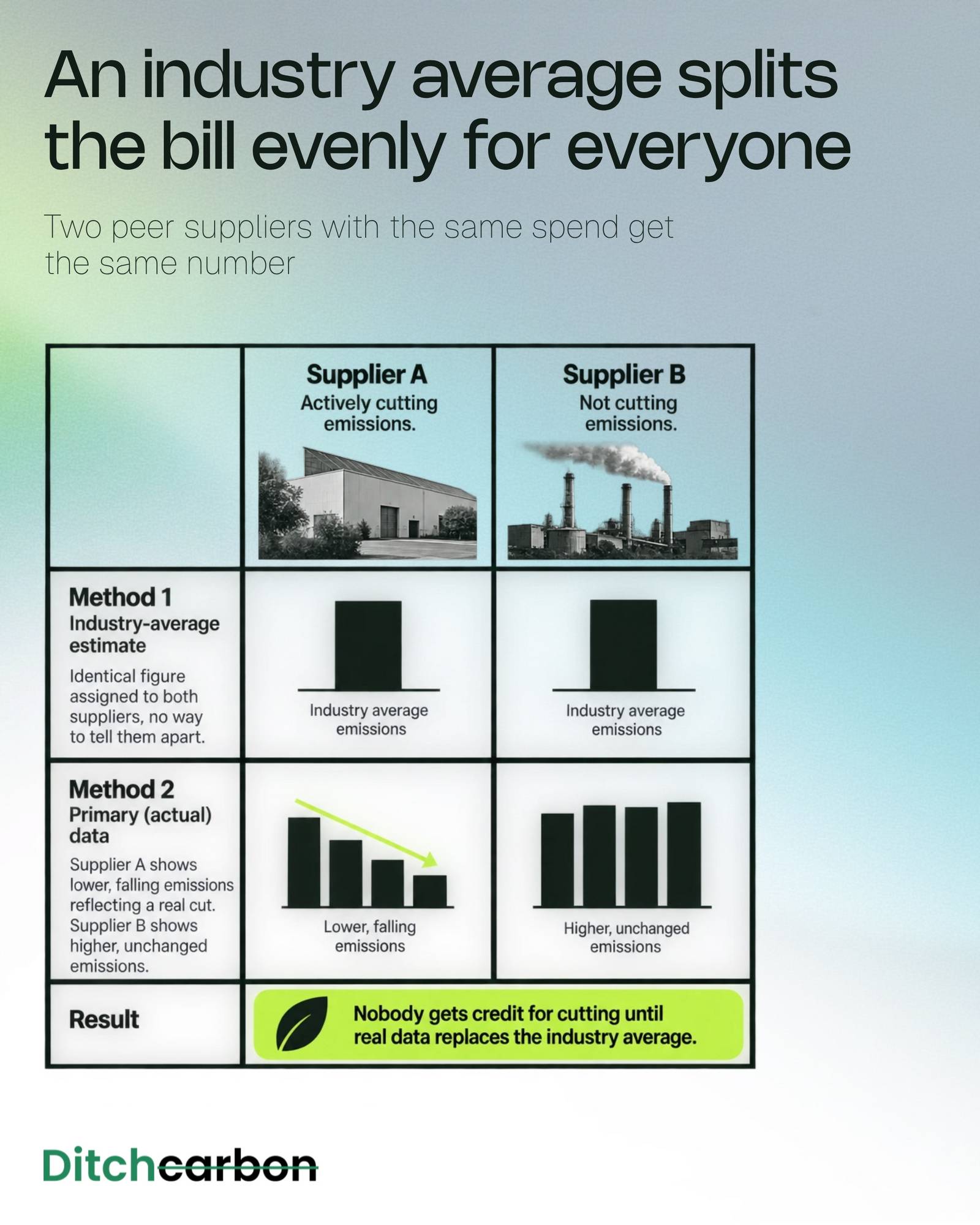
Because spend is an input. The emissions factor you multiply it by decides the answer. Pair spend with a supplier-specific factor and the result can be accurate. Pair it with an industry average and two peer suppliers with the same spend get the same number, however differently they operate.
The Carbon+Alt+Delete channel puts it bluntly: "spend is an input, not an output". With supplier-specific data, spend can be a very accurate way to calculate emissions. With industry factors, "it is totally useless."
That is not a fringe problem. Supply chain emissions, which usually account for around 90% of a footprint, are routinely calculated even at the largest companies using spend multiplied by a US EPA emissions factor, because it is the best available.
It works like splitting the dinner bill evenly. The person who ordered a salad pays for the steak at the other end of the table. With an industry factor, the supplier who has already switched to renewables and the peer still running on fossil power pay the same share of your inventory. Your best performer and your worst performer get an identical emissions line.
Everything they each did at the table disappears into the average. The best performer cannot show you their progress, and you cannot reward it.
So the fix is targeted. You do not need primary data for everyone at the table. You need it for the suppliers whose real figure differs from the average in a way you would act on.
What does primary data buy you that spend cannot?
Credit. When a supplier cuts emissions and you hold their actual figure, your Scope 3 falls with it. With an industry average, their cut vanishes into the sector mean and your inventory does not move. Primary data also gives the supplier credit in your eyes, because you can finally see who is improving.
The Sumday talk frames the board-level version of this well. If your board expects you to credibly track progress towards net zero across Scope 3, the question you have to answer is whether you hold a credible emissions factor that can replace the average you have been using for years. An average cannot show progress, because nothing a supplier does changes it.
Back to the dinner. Primary data is the itemised bill. The salad eater pays for the salad. The supplier who switched to renewable electricity shows a lower line than the peer who did not, and that difference is visible in your inventory.
The suppliers making real progress are the ones who should get your money. Primary data is how you tell them apart, and how you give procurement a reason to prefer them.
This also tells you exactly where a request for primary data earns its cost: suppliers who are material, who you can influence, and who are cutting or about to. Ask them. For those who already disclose, you may not need to ask at all. For everyone else, ask yourself whether a better number would change what you do.
Which suppliers should never get a primary data survey?
Small and long-tail suppliers, immature suppliers, suppliers you have no real influence over, and suppliers in industries like fossil fuels that are not part of the solution. Put them in a box and move on. Chasing their data costs time you could spend on suppliers who will actually cut.
A lot of teams get their knickers in a twist about SME suppliers. Part of the reason those suppliers have no data is regulatory. As a Bureau Veritas session on YouTube notes, large corporates are measuring and disclosing because rules like the UK's Streamlined Energy and Carbon Reporting, CSRD and ESOS push them to, while small and medium-sized businesses sit outside their scope. A survey will not create data that nothing obliges them to hold.
In my experience it is very rare that a supplier is so small and so immature, and also matters to the organisations we work with, that it becomes a problem. When a team worries about their long tail, I tell them to put those suppliers in a box and stop worrying about them.
Here is the skip list, with the reason each one can wait.
That frees your time for suppliers who matter, who you can influence, and who have said they will cut but have not. Send fewer surveys, and have more renewable energy conversations.
Frequently asked questions
Are supplier emissions surveys for Scope 3 worth running?
Rarely, and only for a short list. A survey is worth sending when the supplier is material, you have influence over them, and a real figure would change what you do. For everyone else, spend data and public disclosures are enough to make directionally accurate decisions.Why is Scope 3 emissions data so hard to get from suppliers?
Many suppliers, especially small and medium-sized businesses, sit outside rules like CSRD, ESOS and the UK's Streamlined Energy and Carbon Reporting, so nothing obliges them to measure. A survey will not create data they do not hold. The practical answer is to stop chasing the long tail and focus on suppliers that matter and already disclose or can be influenced.Can you reduce supply chain emissions without primary data?
Yes. Asking material suppliers to move to renewable electricity cuts their Scope 2 and your Scope 3, and you can choose who to approach from spend rank and public disclosures. Primary data becomes useful afterwards, to show the reduction in your inventory.Why does an industry average hide supplier progress?
Spend multiplied by an industry average gives two peer suppliers with the same spend the same number, however differently they operate. A supplier who cuts emissions sees no change in your inventory. Replacing that average with a supplier-specific figure is what lets real cuts earn credit.