CDP Supply Chain responses stalled? Three ways to grow supplier emissions data

CDP Supply Chain gives buyers a recognised, structured way to ask suppliers for climate data once a year. Many programmes find that their CDP Supply Chain response rate levels off after the first few cycles. Here is what CDP data can and cannot do for a Scope 3 inventory, and three ways to grow supplier data from there.
Why do CDP Supply Chain programmes reach a ceiling?
CDP Supply Chain programmes reach a ceiling because responding costs suppliers time and money, and the suppliers best able to carry that cost tend to respond in the early cycles. Around 11,000 companies file a climate response each year. Many of the small and mid-sized suppliers in a buyer's long tail are not among them.
Cost is part of the reason. CDP charges companies an admin fee to disclose, and for the 2026 cycle a UK-headquartered company pays £2,450 at the Foundation tier or £5,985 at the Enhanced tier, according to CDP's admin fee FAQ. The same page says fees are rising by about 5% globally in 2026. The fee is waived for a supplier requested only by Supply Chain members, but a supplier that is also requested by a capital markets signatory pays it.
A waived fee still leaves the work. A full climate response is a substantial document, and many suppliers either hire a consultant to complete it or carry the cost internally. For a supplier with a small sustainability team, a CDP request is one more job on a long list. Small suppliers are the least able to absorb that cost, and they often make up most of a buyer's list by number.
What can CDP data do for a Scope 3 inventory, and where does it stop?
A CDP response gives a structured, comparable account of a company's emissions, targets and governance for one reporting year, and it is a clear signal that the company is engaged. For a Scope 3 inventory, though, it has four limits that a buyer needs to plan around.
Verification is optional. CDP rewards third-party verification of emissions with scoring points, as its verification guidance sets out, and CDP's 2025 supplier webinar with WSP advises suppliers to verify "if possible". A response can be submitted with unverified figures.
Scope 3 can be left unevaluated. Responders complete a row for each Scope 3 category, and "not evaluated" is an accepted answer, according to the CDP and WSP 2025 supplier webinar. A supplier's own Scope 3 breakdown may therefore be thin or absent.
Your share is hard to work out. A response reports the supplier's total emissions. Allocating the right portion to what you buy needs a further calculation that the response doesn't make for you, so two buyers can derive different figures from the same disclosure.
It describes one year. A response covers the last reporting year. Targets are reported, but the response doesn't project where the supplier's emissions are heading year by year, which is what a buyer needs to plan against its own target.
Taken together, these limits mean CDP data on its own can't support an audited sustainability statement. It works best as one input into a calculation that adds the source documents, the allocation and the assurance level an auditor will ask for.
What are the options once CDP responses stall?
There are three routes, and they differ most in what they ask of suppliers and what an auditor can check afterwards.
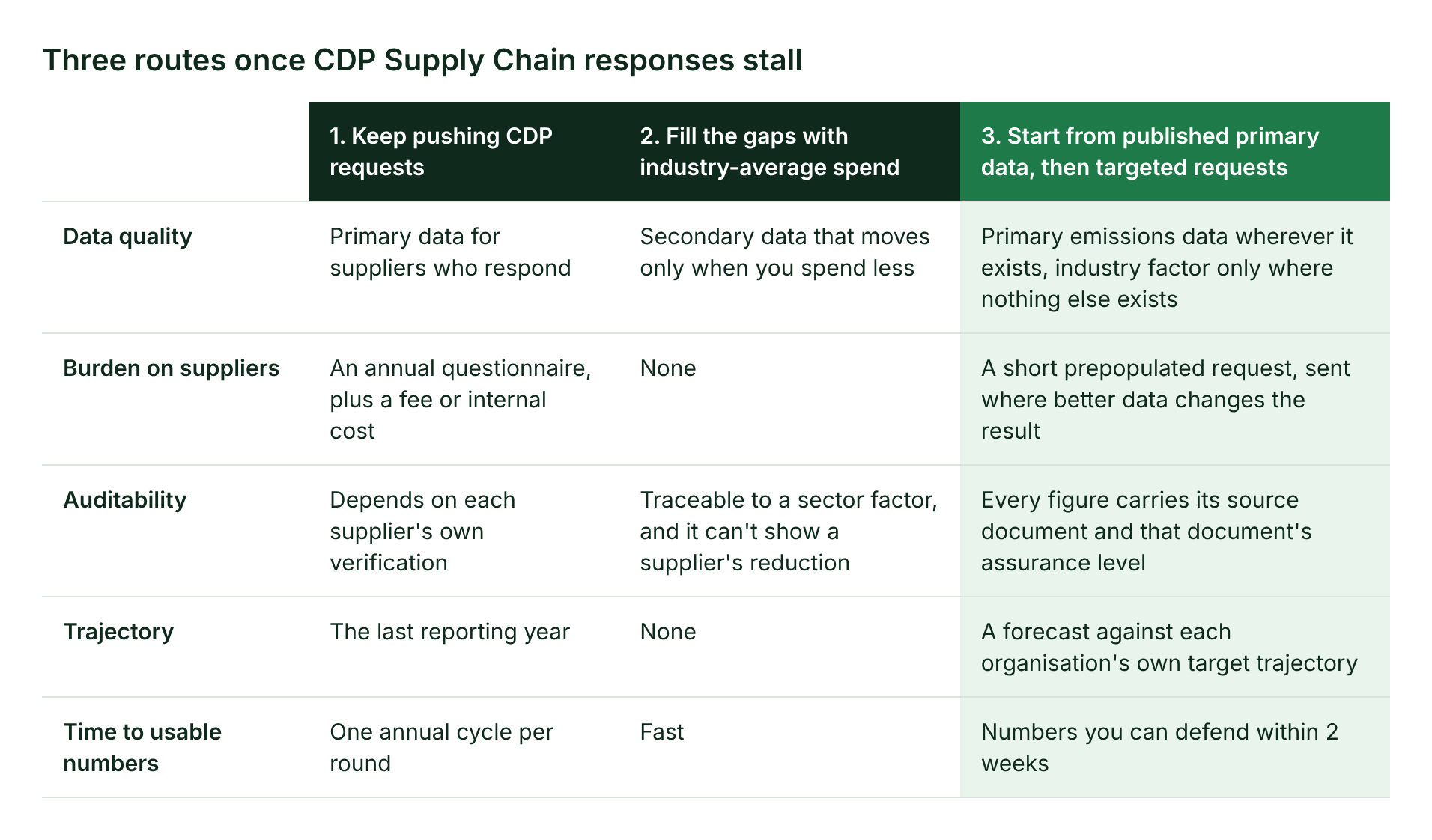
Route 1 suits the suppliers who already respond well to CDP and value the score. Keep them on it.
Route 2 closes the inventory quickly, but it fixes the buyer to sector averages. When a supplier cuts its emissions, the figure stays where it was, so reductions can't be seen or claimed.
Route 3 starts with the data suppliers have already published, including their CDP responses, and applies each supplier's own figures to your spend. Requests then go only to the suppliers where better data changes the result, prepopulated with what they have already disclosed. A recent deployment reached 70% coverage of emissions with primary data within 2 weeks.
The CDP Supply Chain alternatives comparison sets out cost and coverage for each route in more detail.
How do CDP and a Scope 3 emissions platform work together?
CDP's disclosure network and a Scope 3 emissions platform do different jobs. They work well together. CDP collects a structured annual disclosure. The platform turns that disclosure, and everything else a supplier has published, into an auditable calculation the buyer can act on.
DitchCarbon starts from verified emissions data for over 2 million organisations, built on primary emissions data wherever it exists. That includes published GHG inventories and product carbon footprints, CDP responses, EcoVadis scorecards, SBTi targets and data that suppliers declare on their own profiles. A supplier's CDP response sits on the same record as its source documents, with the assurance level each one carries.
When a buyer needs more data from a supplier, the request asks for what is needed to reduce or report accurately and points the supplier to Supplier Support for help. A supplier that improves its disclosure benefits on both sides. Coherent's CDP supplier score went from C to A-.
For buyers who want to keep CDP in place, the answer to whether a CDP score is the same as emissions is a useful companion to this post, and Low supplier response rates on Scope 3 covers what to do when any supplier programme stalls.
CDP asks the questions, DitchCarbon gives the answers to drive your decarbonisation agenda.