.svg)
Supplier engagement model: stop chasing non-responders

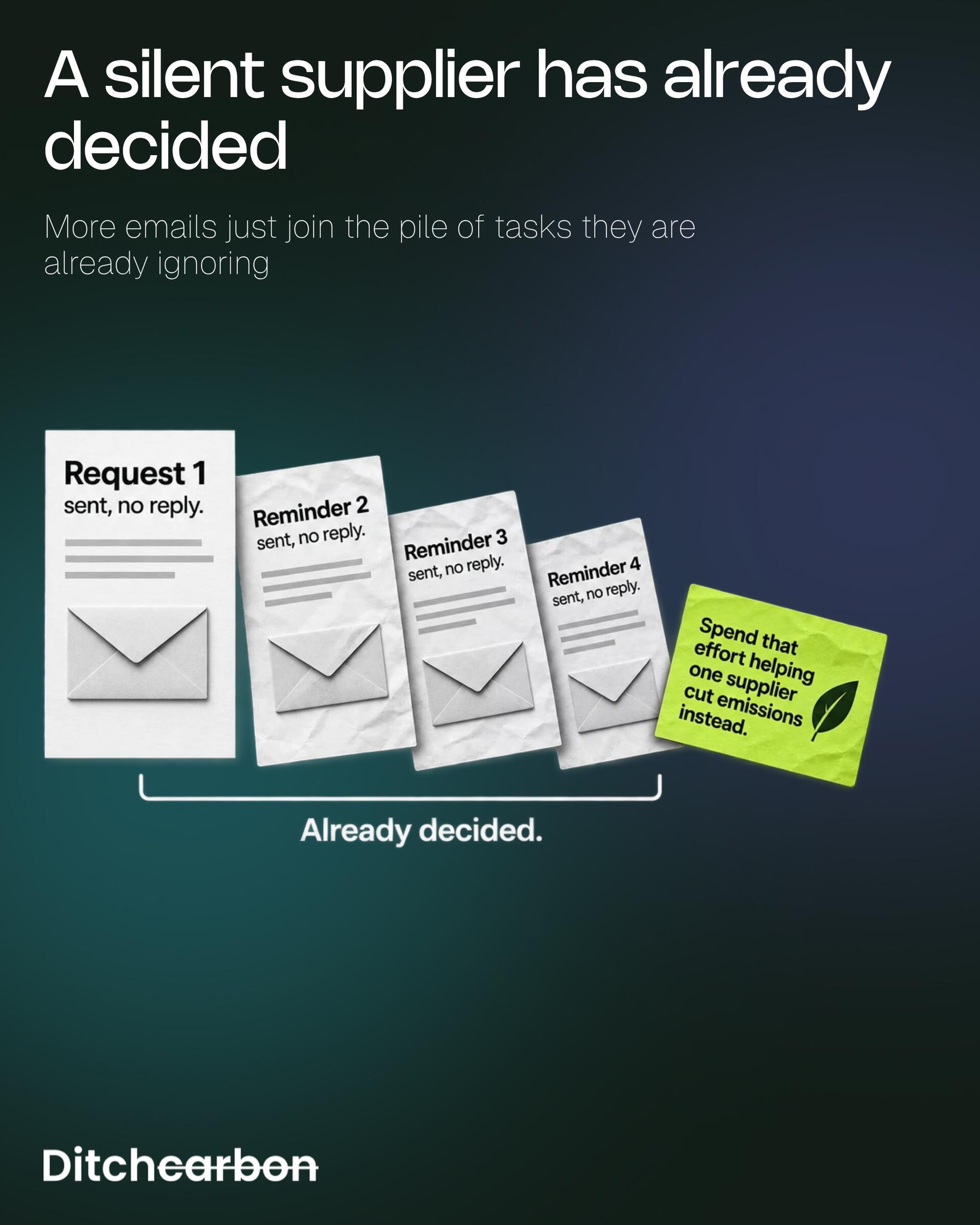
A supplier who ignored the first request has already decided, and more reminders just join the pile of tasks they are avoiding. Treat silence on a small ask as a signal about the relationship. Cut the survey list to suppliers you will act on, and estimate the rest with secondary data, which the GHG Protocol allows. Then spend the saved effort helping one supplier decarbonise.
What does the survey and chase cycle actually cost?
The cycle uses up the time your team had set aside for reductions, and it returns a patchy dataset. A survey goes out to hundreds of suppliers and some reply in the first round. Then the reminders start: a second email, a third, a call from procurement, a nudge from the account manager. Each round brings back fewer answers, and the answers that do arrive still need cleaning.
Anyone who has run one of these surveys will recognise what comes back. PDFs that do not match the template. Fields filled in the wrong units. A sustainability report attached in place of the numbers you asked for. Someone reconciles all of it in one large Excel file. Every reconciliation is a manual adjustment, and every adjustment is another figure you will struggle to defend when an auditor asks where it came from.
The chase feels like progress because it keeps people busy. Emails go out, trackers update, and the response-rate chart edges upward. None of that activity cuts a tonne of carbon. It spends the hours, and often the budget, that the programme needed for the work that does cut carbon: helping suppliers bring their emissions down.
The alternative starts with how you read silence. Treat silence as information about the relationship. Shrink the survey list to the suppliers you will act on. Estimate the rest with secondary data. Then put the effort you save into decarbonising one supplier properly.
| Supplier situation | What to do | Basis |
|---|---|---|
| Material emissions, and you plan to work on reductions together | Survey for primary data | GHG Protocol: primary data for targets and supplier engagement |
| Not prioritised after initial estimation | Estimate with secondary data | GHG Protocol: secondary data for non-prioritised activities |
| Unable to provide data, including private suppliers with no disclosure | Spend-based estimate, method recorded | GHG Protocol: secondary data where primary is unavailable |
| Data provided, but below the quality you need | Use secondary data if it is better | GHG Protocol: secondary data when it beats primary quality |
| Ignores a small gap-fill request | Estimate, and pass to procurement | Silence as a relationship signal |
| No plan or budget to use their data | Leave off the survey list | No decision depends on the answer |
Why are suppliers not responding to your Scope 3 survey?
They have already decided. A supplier who ignored the first request has weighed it against everything else on their list and put it at the bottom. A reminder leaves that decision where it was and adds one more unwanted task to a pile they are already ignoring. Sending more emails does not help.
You can see the same thing in your own inbox. Tasks we would rather not do slip down the list easily, unless there is a clear reason to do them sooner. A third reminder carrying the same request gives the supplier no new reason. The only thing that has changed is the date at the top.
Think of a sales rep still emailing a lead who has stopped opening their messages. The rep logs each send as activity, and the pipeline report looks healthy. The lead has moved on, and every extra email makes the rep easier to ignore. Chasing a silent supplier works the same way. The tracker shows effort, the supplier sends nothing, and your team's hours disappear into the gap between the two.
Good sales teams learn to read that silence. They qualify the lead out, spend their time on accounts that are live, and return to the dead lead only when something changes. Procurement and sustainability teams rarely give themselves the same permission. The default is to keep chasing until the reporting deadline, because a non-response feels like a gap you are personally responsible for closing.
It is a gap. It is also an answer, and that answer is worth reading.
What does silence on a small ask tell you?
It tells you the supplier is not engaged with you as a customer. When the request is tiny, cost and complexity stop being believable reasons for not replying. The only explanation left is priority, and you are not one of theirs.
Take a supplier that has already published its full greenhouse gas inventory but left out business travel. A well-built request arrives with everything they have already disclosed filled in, and asks only for the missing category. For a team that produced the rest of the inventory, that is a short job. Prepopulated requests like this get higher supplier response rates than a cold survey, because the supplier can see how little is left to do.
So when a supplier ignores even that request, the silence carries meaning. They have the data, or can get it easily. They have chosen not to send it to you. This is the lead who stopped opening your emails, and a fourth reminder will not change their mind.
The useful response is a commercial one. Pass the silence to the category manager who owns the relationship. Ask whether this supplier shares your values and treats you as a customer worth answering. For some suppliers, the silence will prompt a harder conversation at the next contract review. For others, it may be a reason to reconsider the relationship entirely. Either way, the decision belongs to procurement, and it is a better use of the signal than another email.
Why do so many supplier surveys produce nothing?
Many surveys start without a plan for the data, or with a plan and no budget to carry it out. When that happens, the survey becomes the whole programme. Time and money go into collecting answers, and nothing happens once the answers arrive.
In a conversation with a Scope 3 peer group, I heard people describe building surveys they could not answer themselves. Others were building surveys with no real idea of what they would do with the results. The worst cases were teams who knew exactly what they wanted to do next but had no budget to do it. All they had left to spend their time and money on was the survey.
Before any supplier goes on the list, ask one question: what will I do with this answer? If the data feeds a reduction target, a funded supplier programme or a sourcing decision, ask for it. If it will sit in a spreadsheet to lift a coverage percentage, it is hard to justify the supplier's time or yours.
The same question exposes surveys that have grown beyond their purpose. If your own team could not fill in the survey for your own organisation, a supplier with a smaller sustainability function will not manage it either. Every question you cannot tie to a decision gives the supplier another reason to push the whole survey down their list. It is also one more reason your response rate stalls after the first round.
A survey with no plan behind it wastes the supplier's time as well as yours. The hours they spend filling in fields you will never use are hours they could have spent on their own operations.
Which suppliers belong on the survey list?
Only the suppliers you will act on. For everyone else, estimate their emissions with secondary data and say so in your disclosure. The standard itself supports this. The GHG Protocol's guidance says companies should collect secondary data for activities not prioritised after initial estimation, and where a value chain partner is unable to provide data. What the guidance requires is transparency. You must report the types and sources of data you used, and the percentage of emissions calculated from supplier data. It sets no minimum number of follow-ups.
The same guidance links the type of data to your goal. If the goal is to set reduction targets, track performance or engage suppliers, you should choose primary data. If the goal is to understand relative magnitude, find hotspots and decide where to collect primary data, you should choose secondary data. The survey list therefore follows from your plan, and chasing harder cannot improve it.
This matters most for private suppliers that publish nothing. For them, a spend-based estimate using a published factor set such as CEDA, DEFRA or EPA gives you a starting figure you can defend. Record the method and source against each number so the estimate stays auditable.
The table below sorts suppliers by what each one needs from you.
Where should the saved chase effort go?
Put it into one supplier you can help decarbonise directly. Choose a supplier with material emissions and a relationship worth investing in. Then spend the hours and budget you would have spent chasing on reductions at that supplier.
The evidence supports working with suppliers on reductions. CDP's Strengthening the Chain report found that suppliers disclosing through CDP reported that engagement from their buyers led to 43 million tonnes of emissions reductions, more than the total annual emissions of Sweden. The same report found suppliers were 52% more likely to reduce their annual emissions when their buyers offered financial incentives, compared with buyers who only provided training.
That second figure shows where the money should go. Budget freed from survey administration can become an incentive a supplier will act on. Tie it to a specific reduction at a specific site, and follow the result through your own inventory.
Newer frameworks point the same way, and they are still changing. The SBTi Corporate Net-Zero Standard V2.0 is designed to help companies strengthen implementation and demonstrate progress on decarbonisation. A measured reduction at one supplier is progress you can show. A slightly higher response rate is harder to point to.
Return to the sales rep. The rep who stops emailing the dead lead and spends the afternoon on a live account closes more business. The same holds for Scope 3. Work with the supplier who is willing to act, and let the silent ones tell you what you need to know about the relationship.
One supplier cutting emissions beats fifty half-finished surveys.
Frequently asked questions
What should I do when suppliers are not responding to my Scope 3 emissions survey?
Stop sending reminders once the first round has closed. A supplier who has not replied has usually already decided, and more emails will not change that. Estimate their emissions with secondary data, and pass the silence to the category manager as information about the relationship.How do I estimate Scope 3 emissions for non-responsive suppliers?
Use secondary data, which the GHG Protocol's guidance allows where a value chain partner is unable to provide data. For private suppliers with no disclosure, a spend-based estimate using a published factor set such as CEDA, DEFRA or EPA is a defensible starting point. Record the method and source against each figure, and report the share of emissions calculated from supplier data.Which suppliers should I ask for primary emissions data?
Ask the suppliers you will act on: those with material emissions, where the data feeds a reduction target, a funded programme or a sourcing decision. The GHG Protocol links primary data to goals such as setting targets and engaging suppliers. For hotspot analysis and prioritisation, secondary data is the right choice.What are best practices for engaging suppliers on emissions data collection?
Keep the list short and the requests small. Where you can, prepopulate each request with what the supplier has already disclosed, and only ask questions you know how you will use. Then put the effort you would have spent chasing into helping one supplier reduce emissions, for example through financial incentives, which CDP found more effective than training alone.