Two Scope 3 programmes, two years on

You set a Scope 3 target and the clock started the day you announced it. Two sustainability teams start the same quarter, each with a spend file of several thousand suppliers, a Scope 3 baseline to build and that clock running. One decision in the first month decides whether the next two years go on asking or on cutting. Both teams are composites.
What does the first month of a Scope 3 programme look like?
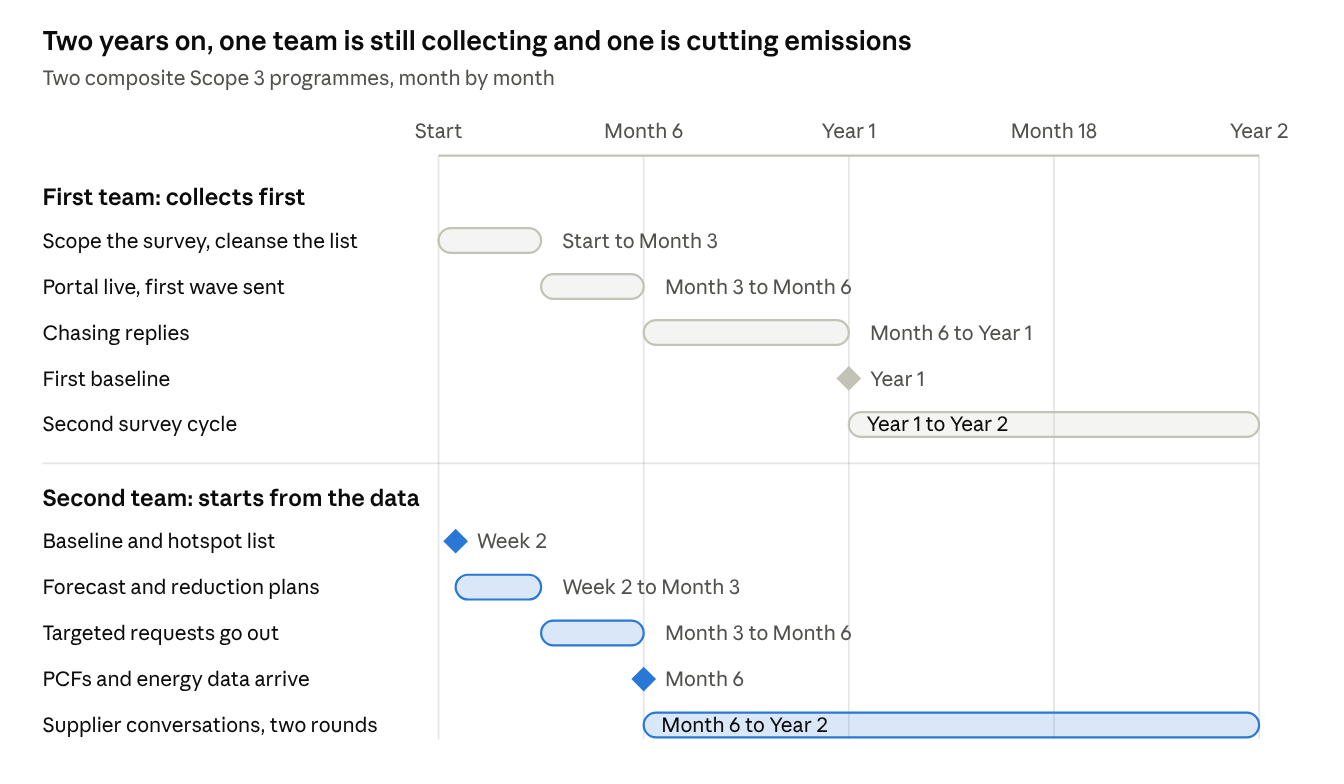
The first team decides that the baseline has to be built from data collected from suppliers, so the first month goes on building the means of collecting it. A survey programme is scoped, or an ESG data platform is selected and onboarded. The supplier list is cleansed so it can be loaded. A questionnaire is drafted, reviewed by legal and translated. Category managers are briefed on which suppliers to chase. Nothing has been measured yet, and nothing can be until suppliers reply, because this model has to ask before it knows anything.
The second team uploads its spend file as it is, with supplier names, amounts and whatever identifiers the ERP holds, into DitchCarbon. Every supplier on it is matched to a profile drawn from verified emissions data for over 2 million organisations, built on primary emissions data wherever it exists. Where a supplier has published a GHG inventory, its own emissions are allocated to the team's spend with it. Where it has published a product carbon footprint for something the team buys, that footprint is matched to the lines where the product is bought. Where it has published nothing, an industry factor fills the line and the line says so.
By the end of week two the second team has numbers it can defend: a baseline by category and by supplier, a hotspot list sorted by embodied emissions, and a method marker on every line showing whether the figure is the supplier's own, product level, activity level or industry average. A recent deployment reached 70% coverage of emissions with primary data within 2 weeks. The first team, at the same point, has a questionnaire.
The first team's month went on building a way to ask. A programme that cannot measure anything until suppliers reply has handed its start date to other people, and your target date does not move to match.
What can a team do once the baseline is behind it?
Three months in, the second team has stopped talking about the baseline. This is the work the team came to do, and it starts in month three because the data was already there in week two. Three things now stand on that baseline.
Forecasting against each supplier's own trajectory
Each supplier's emissions are projected against that supplier's own target trajectory, and the projections roll up to category and account level. The team can see where its Category 1 total lands in 2030 if every supplier does what it has said it will do, and which categories carry the shortfall. That is the conversation with the finance director, and it comes from data the team already holds.
Reduction plans drawn from peers
For each supplier at the top of the hotspot list, the platform ranks the reductions available to it, in tonnes, drawn from what that supplier's peers have already done. The team arrives with a plan, no survey and enough data to drive the conversation. For the suppliers whose trajectory already meets the target, the plan is to get out of their way and let them carry on.
Supplier electricity
Where a supplier has published its inventory, its Scope 2 is in it, so the team can already see which of its largest suppliers run mostly on grid electricity. Decarbonising suppliers' electricity supply is where much of the reduction work at scale sits, and those conversations start with the suppliers where the lever is biggest, because the team already knows which ones they are.
The first team, at the same point, is loading its cleansed supplier list into the portal and deciding the spend threshold above which a supplier will be asked. Its baseline is still a line on the project plan, and its target date is three months closer.
Which budget round will your reductions be in?
Reductions cost money, and money is allocated once a year. If you want to reduce next year, you need to know this year exactly what you want to do and what it will cost: which suppliers, which lever at each one, and how many tonnes it buys. That is what goes in front of finance, and the budget round does not wait for a baseline to finish.
Three months in, the second team has it. The hotspot list says which suppliers, the ranked plans say which lever and how many tonnes, and the forecast says what the target still needs once the suppliers already on track have done their part. The team can cost a programme of work with the suppliers it intends to approach and put the number into this year's budget round, for reductions that start next year.
The first team cannot, and this is the hidden cost of a survey programme or a long platform implementation. Its baseline arrives around year one, after this year's budget round has closed. The first costed plan it can write goes into next year's round, and the money arrives the year after that. The second team's reductions are a year into delivery by then. Nobody chose that delay. It is what the budget calendar does to a programme that has to ask before it knows anything.
Who gets primary data from suppliers first?
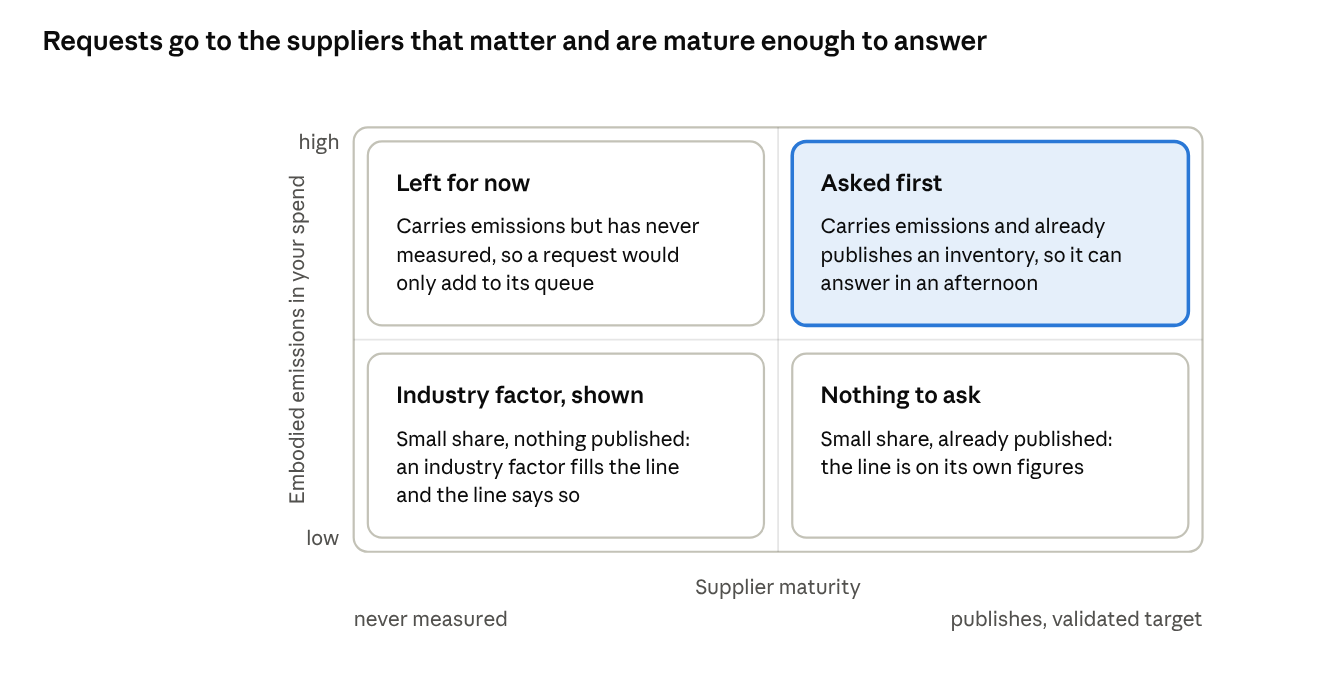
Six months in, the first team's portal is live. The questionnaire has gone to every supplier above a spend threshold, because without any data the team has no other way to decide who matters. Each supplier receives the same blank form and is asked to compile an inventory, whether or not it has ever measured anything. Replies come from the large suppliers that already publish a sustainability report, which is where the data was least needed. Down the tail, the questionnaire is a request for unpaid work from companies with no reason to prioritise it, and the response rate becomes the ceiling on the whole programme. The team spends the summer chasing.
Don't waste your suppliers' time on surveys, or your own. Every blank form sent to a supplier that has never measured anything costs that supplier's time and yours, and nobody gets a reduction out of it.
The second team has not sent a survey. Its baseline already shows which suppliers carry the emissions, and alongside the tonnes it shows how mature each one is: whether it discloses, whether it has a target and whether that target is validated. The requests go to the suppliers at the top of both lists, the ones that matter and are mature enough to answer. A supplier that already publishes an inventory can answer a question about one facility's electricity use or one product's footprint in an afternoon. A supplier that has never measured anything cannot, yet, and asking it in month six would only add to its queue.
What does a lighter request actually ask for?
Each request leaves from the portfolio view already carrying what DitchCarbon holds on that supplier, so nothing it has disclosed is asked for again. What it asks for is what the team needs in order to reduce: a facility's energy consumption and renewable share, the activity data behind a purchase, a product carbon footprint for a named item, a decarbonisation plan where one exists. An ask that small gets answered. A recent deployment gained additional primary data from 30% of over 40,000 recipients.
The product carbon footprints that come back are graded by the PCF Evaluator on arrival, then matched automatically to the lines where that product is bought, which takes the reduction plan for that supplier down to the product level. A facility's energy consumption and renewable share turns the electricity conversation from a Scope 2 total into a plan for a named site. So by month six the second team holds supplier-specific (primary) emissions at spend, activity and product level on the suppliers that matter, with plans already attached to them, and the first team is still waiting for its forms.
What happens to a Scope 3 baseline while nobody is asking?
The first team's figure only moves when the first team moves it. A sector average applied to spend produces a number that changes when procurement spends less, and for no other reason. Until a supplier returns the form, nothing it does to cut its own emissions shows up anywhere in the baseline.
The second team's figure moves on its own. Much of its baseline rests on suppliers' own reported inventories applied to spend, which is primary data under the GHG Protocol even though the input is a line of spend, because the factor came from the supplier itself. When a supplier publishes its next report, the line updates. When a supplier that was on an industry factor publishes for the first time, the line moves up the hierarchy with nothing further from the team, and nothing from the supplier beyond the report it was publishing anyway. Activity and product data that suppliers have already provided through DitchCarbon for other clients, and agreed to share, is there too. A disclosure made privately for one client stays with that client.
The first team's baseline is as accurate as its last survey round, and stays that way until the next one. The second team's is more accurate in month twelve than it was in month one, and nobody on the team sent anything to make it so. Efficiency in Scope 3 is a number that gets better while your people work on reductions.
Don't spend two years asking
Two years in, the first team has a working collection programme. The portal is live, the response rate has crept up with each round, and the baseline is refreshed annually from whatever comes back. The programme is now a fixed cost: a questionnaire cycle every year and a team chasing it, for a figure that moves once a year. Reduction work is on the roadmap for when coverage is good enough, and the first costed plan has only just gone into the budget round. The target date has not moved.
The second team is on its second round of supplier conversations. The first round's plans are in flight, funded in last year's budget round, and the forecast shows which ones are landing. The primary data it holds has deepened, because every reply moved a line up the hierarchy and every newly published report arrived on its own. The suppliers it asked were the ones that could answer and whose answers changed the number.
Neither team worked harder than the other. The difference is what the first two weeks were spent on, and any model that has to ask every supplier before it knows anything will spend its first two years asking, whoever is running it. Your targets will not wait for that, and neither will the planet. Start from what suppliers have already published, keep the request for what you still need from the suppliers that matter, and spend the two years on reductions. That is what DitchCarbon is for: the data is where the programme starts, so you move faster, ask for less, and give yourself a real chance of hitting the goals you set.