.svg)
Organisation maturity ladder
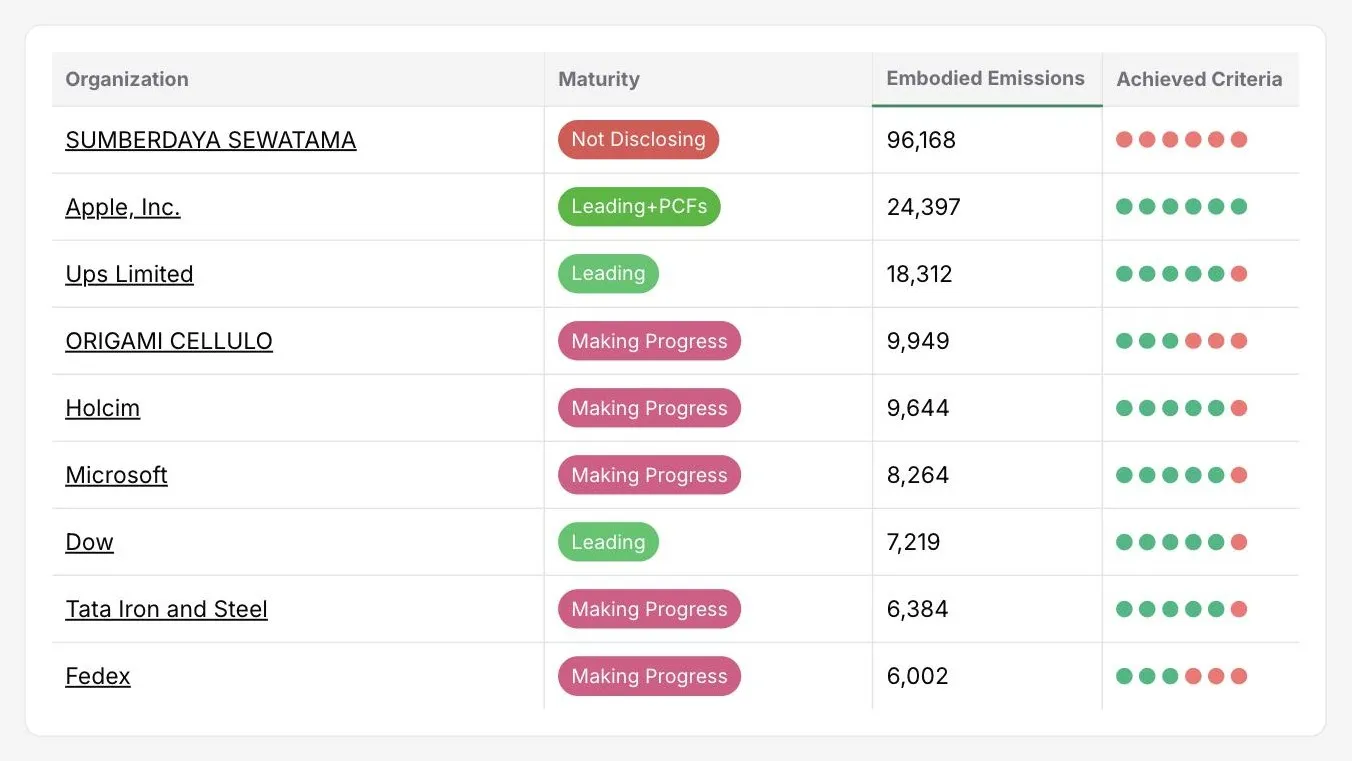
DitchCarbon places every organisation in a portfolio on a four-step maturity ladder, from not disclosing through to publishing product carbon footprints (primary data), with the criteria each one has met shown alongside.
Every organisation sits on one of four steps: not disclosing, making progress, leading, or leading with product carbon footprints. The criteria each has met are listed beside it, and the ladder sorts against embodied emissions, so a large supplier on the bottom step is immediately visible.
A disclosure yes or no hides most of what a procurement team needs. An organisation publishing a full inventory with third-party assurance and one publishing a single Scope 1 figure both count as disclosing, and they are not remotely the same counterparty.
The ladder separates them. Not disclosing means nothing published. Making progress means some scopes reported. Leading means a fuller inventory with targets. Leading with product carbon footprints means product-level data, which is what a category team needs to compare two suppliers on the same component.
Reading it against embodied emissions is where it earns its place. A supplier that carries a large share of your footprint and sits on the bottom step is the highest-value engagement in the portfolio, and that combination is hard to see in any other view.
Coverage gaps are shown, not hidden, so an organisation with nothing published reads as exactly that rather than as a zero.
Common questions

See it on your own suppliers, portfolio or profile
Numbers you can defend within 2 weeks, or one profile that answers every buyer asking.