.svg)
Ranked reduction recommendations
DitchCarbon's reduction recommendations rank every organisation and emissions category in a portfolio by how much of the total footprint acting on it would move, and attach a peer that has already done it.
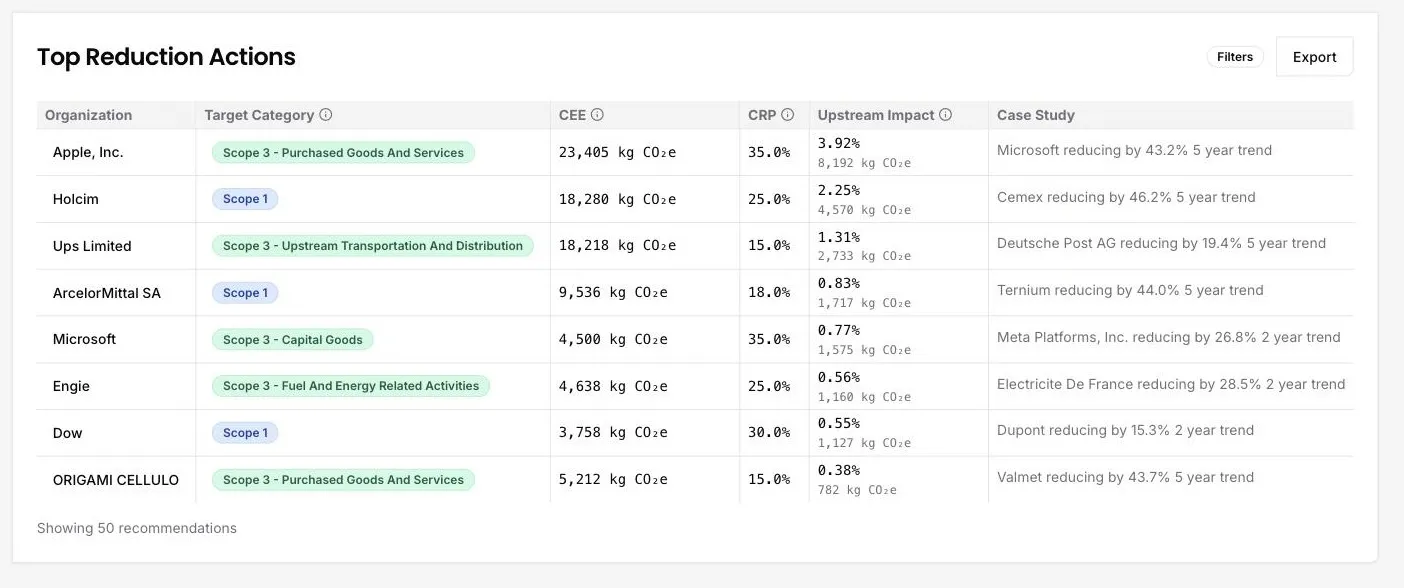
Every organisation and emissions category in the portfolio is ranked by the share of your total footprint that acting on it would move. Each line carries a realistic reduction percentage, the tonnes behind it, and a named peer already reducing at that rate, so the shortlist arrives with its own precedent.
The hard part of reduction is not knowing that emissions should fall. It is knowing which of four hundred suppliers to call first, and what to ask them for once you have.
Each recommendation names an organisation and a specific scope or Scope 3 category, rather than the organisation alone. A supplier can be unremarkable overall and still be the single largest line in purchased goods and services, and it is the line that gets actioned, not the average.
Three columns carry the ranking. CEE is the category embodied emissions: the kg CO2e in that scope or category attributable to your spend with the organisation. CRP is the carbon reduction potential: the percentage reduction in that category a peer has shown is achievable. Upstream impact is the share of your total upstream embodied emissions the reduction would move, and it is the sort order, so the conversations that change the number sit above the conversations that are merely easy to have.
The case study column names a peer in the same sector that has already reduced at a comparable rate, with the trend period stated. It turns an ask into a precedent, which is a materially easier conversation than asking a supplier to go first. Open the row and the whole supplier reduction plan is there: goal, action plan, questions, contract clause and the sourced evidence.
Filter by project, industry, region, year, category or peer type (direct competitors, similar companies or all peers), or export the list as CSV for the procurement team.
Common questions

See it on your own suppliers, portfolio or profile
Numbers you can defend within 2 weeks, or one profile that answers every buyer asking.