.svg)
Entity matching on DUNS, LEI, ISIN and VAT
DitchCarbon matches an organisation to the right legal entity using DUNS, LEI, ISIN and VAT identifiers alongside name, website domain and email, so emissions land on the entity rather than the group.
Identifiers, not name matching. An organisation can be added or matched on DUNS, LEI, ISIN or VAT number, with website domain, email, HQ region and industry as supporting signals. Parent and subsidiary relationships are resolved as well, so a figure attaches to the entity you buy from rather than the group above it.
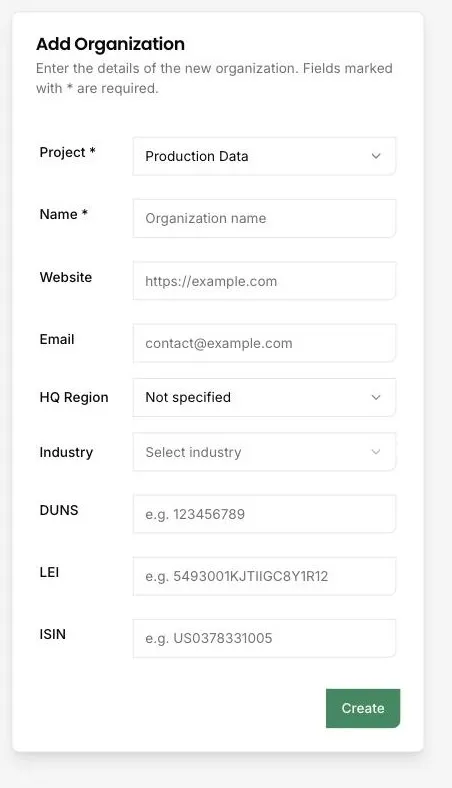
Name matching is where supplier emissions data quietly goes wrong. Three entries for the same organisation, a subsidiary counted twice, a parent's disclosure attached to a local operating company that never published anything.
Entity resolution against DUNS, LEI, ISIN and VAT identifiers removes that whole class of error. The identifier is the join, and the name is a label on top of it.
For a finance team the same mechanism is what makes a PCAF data quality score meaningful. A DQ score describes how close the data sits to the counterparty, so it only holds if the counterparty was identified correctly in the first place.
Organisations can also be added one at a time, with the identifiers supplied at the point of creation and yearly spend entered straight afterwards.
Common questions

See it on your own suppliers, portfolio or profile
Numbers you can defend within 2 weeks, or one profile that answers every buyer asking.