.svg)
Organisation and industry factor comparison
DitchCarbon's emission factor comparison switches a Scope 3 baseline between organisation-specific (primary) emission factors and industry averages, so a team can see how much of the number rests on what organisations actually published.
One toggle answers it. Switch the headline emissions figure to industry emission factors only, then switch back to organisation emission factors where they exist. The difference between the two numbers is how much of your baseline rests on what organisations actually published, rather than on a sector average.
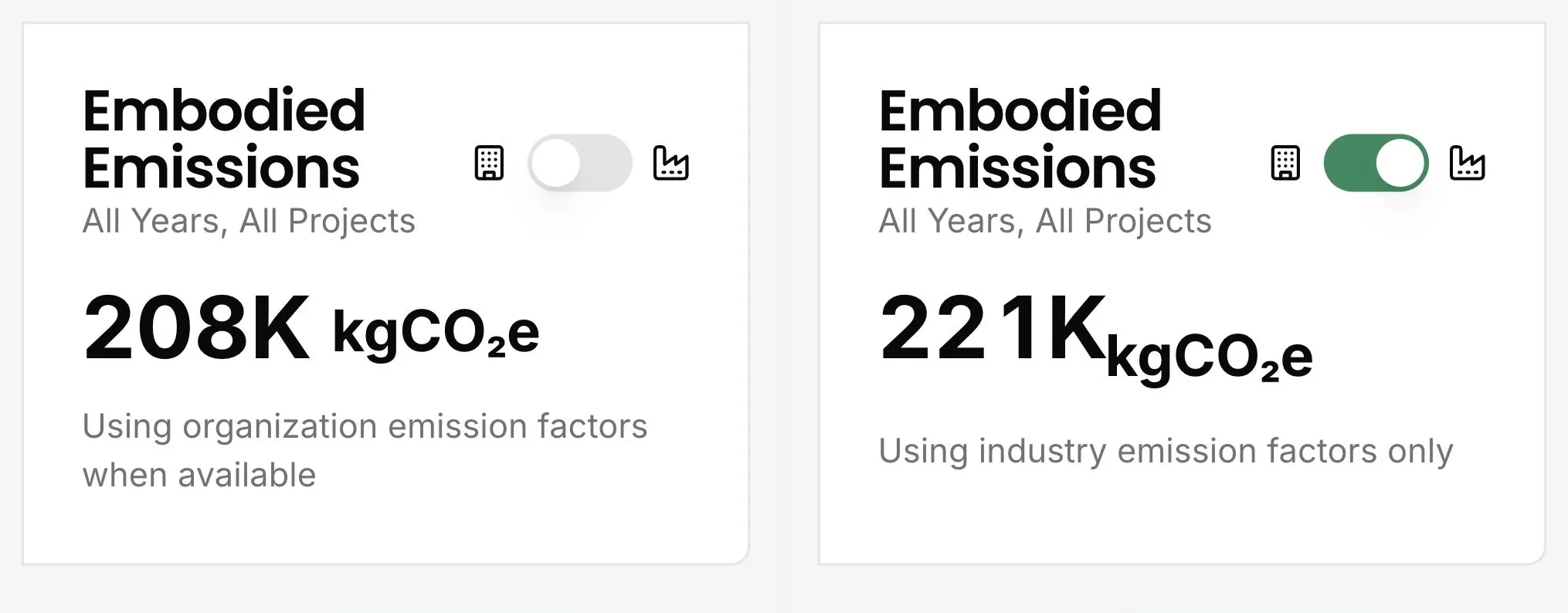
Most Scope 3 baselines are spend-based: multiply spend by a sector average and accept the result. That is fast, and it hides which parts of the number are real. This comparison makes the split visible.
Where an organisation has published its own emissions, the calculation uses its organisation emission factor. Where it has not, the calculation falls back to the sector average, and the toggle shows what that fallback costs you in accuracy.
For an auditor, this is the auditable version of the same question. Rather than asserting that a baseline uses primary data, you can show the two figures side by side and point at the gap.
It also shows where engagement would pay. The organisations sitting in the sector-average half of the number are the ones worth asking for data, and the ones where a single disclosure moves the total. The data underneath covers over 2 million organisations, so for most supplier lists the organisation-specific half is larger than teams expect.
Common questions

See it on your own suppliers, portfolio or profile
Numbers you can defend within 2 weeks, or one profile that answers every buyer asking.