.svg)
Choose your emission factor set
DitchCarbon lets a team pick which published emission factor set is used for every spend-year calculation and export, defaulting to CEDA 2025, so the whole account calculates on one dated, declarable basis.
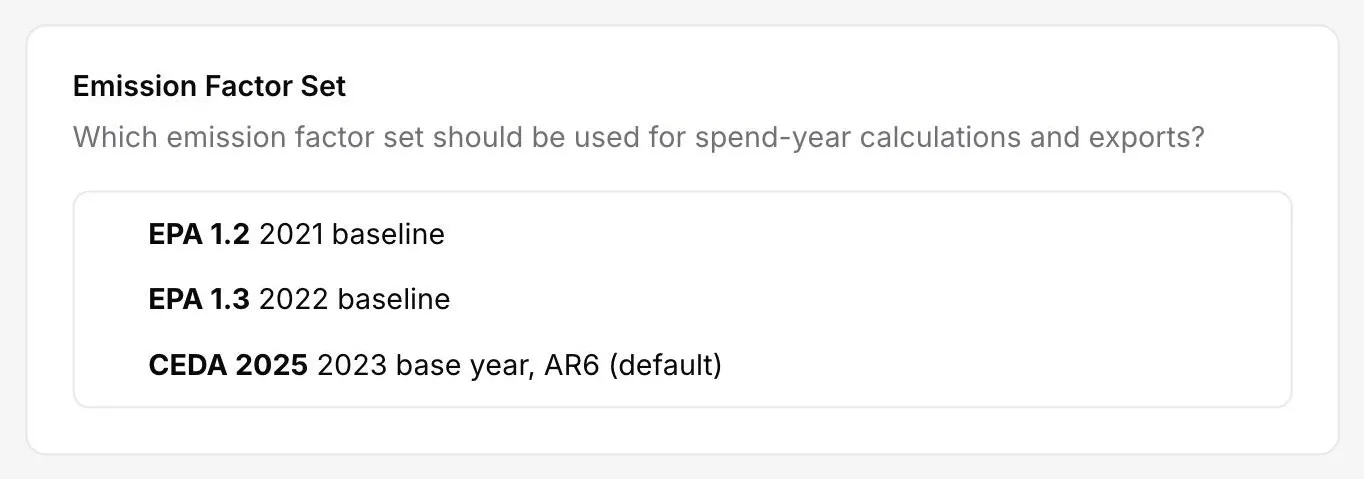
One team setting picks the emission factor set behind every spend-year calculation and every export. CEDA 2025 on a 2023 base year with AR6 global warming potentials is the default, with EPA 1.3 on a 2022 baseline and EPA 1.2 on 2021 also available. The whole account then calculates on one dated, declarable basis.
Spend-based calculation is only reproducible if the factor set behind it, primary or the secondary sector average, is pinned. Two teams running the same vendor list on EPA 1.2 and on CEDA 2025 get different totals, and neither number is wrong, which is exactly the conversation an auditor will not accept.
Setting it at team level rather than per calculation is deliberate. It means a baseline, a restatement and an export all share a basis, so a year-on-year comparison is a real comparison rather than an artefact of a changed factor set.
Each option carries its vintage, and that detail does more work than it looks. EPA 1.2 sits on a 2021 baseline and EPA 1.3 on a 2022 one. CEDA 2025 uses a 2023 base year and AR6 global warming potentials, and the move from AR5 to AR6 alone shifts a restated figure, so a reader needs to know which basis produced the number in front of them.
The setting applies to exports as well as on-screen figures, so a workbook handed to an auditor calculates on the basis the methodology note describes.
Common questions

See it on your own suppliers, portfolio or profile
Numbers you can defend within 2 weeks, or one profile that answers every buyer asking.