.svg)
Fallback logic when an organisation has not reported
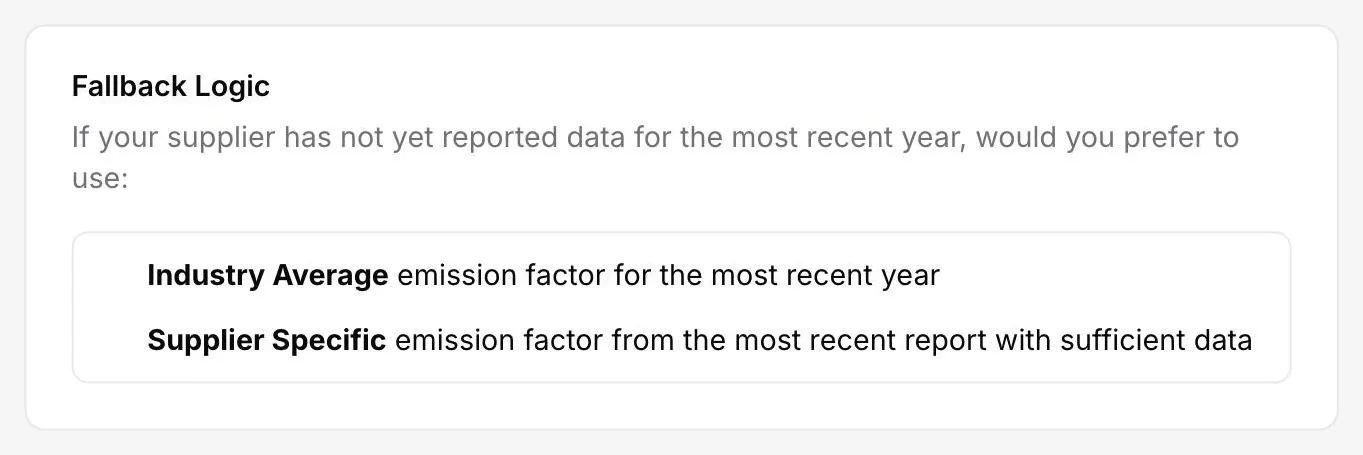
DitchCarbon lets a team choose what happens when an organisation has not reported for the most recent year: an industry average for that year, or that organisation's own most recent sufficient report.
You choose, once, for the whole account. Either an industry average for the most recent year, or that organisation's own most recent report with sufficient data. One favours comparability across the portfolio, the other favours organisation-specific (primary) accuracy, and the choice is recorded rather than assumed.
Reporting lags. An organisation that published in June for the prior year has not published for the current one, and something has to fill that cell. Most tools pick silently, and the reader cannot tell which convention produced the total.
Making it an explicit team setting turns a hidden assumption into a stated policy. Industry average for the most recent year keeps every organisation on the same vintage, which suits a portfolio being compared internally. Organisation-specific from the last sufficient report keeps the primary data you already have, which suits a baseline where accuracy per counterparty matters more than a common year.
Neither is the right answer everywhere, which is the reason it is a setting. What matters for assurance is that the convention is declared, applied consistently, and visible next to the calculation method breakdown that shows what share of the total it affects.
Every figure carries its source and change history, so a fallback is identifiable as a fallback rather than passing as a report.
Common questions

See it on your own suppliers, portfolio or profile
Numbers you can defend within 2 weeks, or one profile that answers every buyer asking.