
Supplier carbon scorecard
DitchCarbon's supplier carbon scorecard puts each organisation's score against its industry, its reported emissions, its climate goals and their progress, and its climate initiatives on one page, so a buyer can judge a supplier at a glance.
Everything a buyer needs to judge one organisation, on one page: the DitchCarbon score against its industry, how carbon-intensive the industry is and whether it is improving, reported emissions by scope since 2018, each climate goal tracked as on track or at risk, Scope 3 by category, and the climate initiatives it has joined.
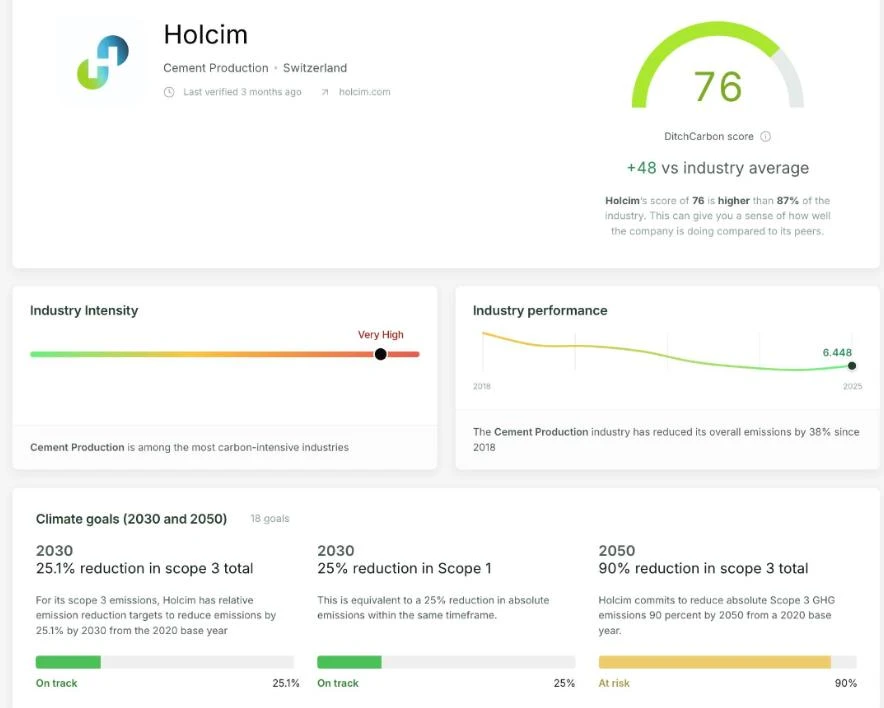
A buyer reviewing a supplier ahead of a sourcing decision or a quarterly review needs the whole picture in one place. The scorecard opens on the score: Holcim scores 76, 48 points above its industry average and higher than 87% of cement producers.
The industry context comes next. Cement is among the most carbon-intensive industries, and the sector has cut its emissions by 38% since 2018, so the score reads against the sector the supplier sits in. Reported Scope 1, 2 and 3 emissions follow, with the trajectory since 2018 and a plain-language summary of the company's targets.
Then the commitments, checked against the numbers. Each climate goal shows whether the organisation is on track or at risk: Holcim is on track for its 2030 Scope 3 target and at risk on its 2050 one. Scope 3 is broken down by the categories the company discloses, and every climate initiative it belongs to is listed as active or not.
Each block opens into its own detail, from the criteria behind the score to the source documents, so the scorecard is where a supplier review starts. The same profile is public, so a supplier sees what its customers see.
Common questions

See the scorecard for your own suppliers
Numbers you can defend within 2 weeks, or one profile that answers every buyer asking.


 Peer Insights
Ditch Carbon Ltd
167-169 Great Portland Street
London W1W 5PF
