.svg)
Reduction targets register
DitchCarbon holds every reduction target an organisation has published, with its scope, base year, target year, reduction rate, target type, source and the original wording.
Every target in one register: scope, on-track status, classification such as absolute or net zero, base year, target year, reduction rate, and its source. Targets validated by the SBTi are marked as such, targets taken from a report link to the document, and the original wording is quoted in full.
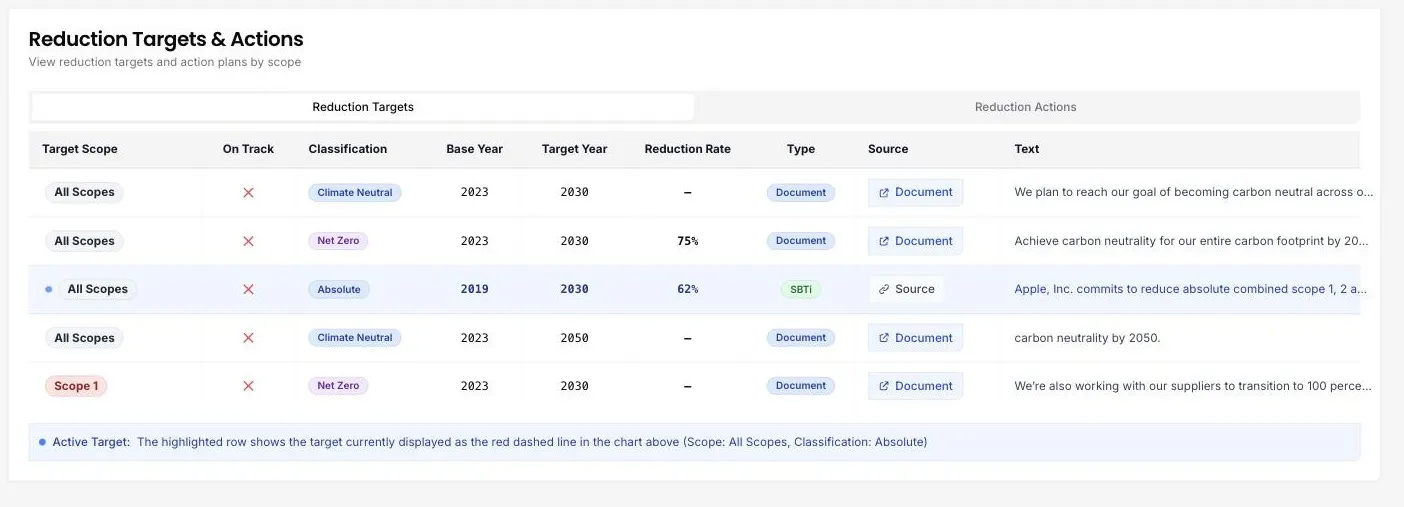
Two organisations can both claim a 2030 net zero commitment and mean entirely different things. One has a validated absolute reduction across all three scopes, the other a carbon neutrality statement covering operations only. The register keeps them distinguishable.
Classification is what does that work. Absolute, net zero and climate neutral are separate types, and a target's scope is recorded as all scopes, Scope 1, Scope 2, Scope 3 upstream or Scope 3 downstream rather than flattened into one label.
The verbatim text matters most in a supplier negotiation. When a contract clause has to reference a supplier's own commitment, quoting their published wording is stronger than paraphrasing it.
Reduction actions sit alongside the targets, so a commitment can be read next to what the organisation says it is doing about it.
Common questions

See it on your own suppliers, portfolio or profile
Numbers you can defend within 2 weeks, or one profile that answers every buyer asking.